

I am often asked what matters most in the first hour of a crisis.
- Not the wording of the statement.
- Not the headline.
- Not the volume of coverage.
What matters is behaviour.
After years at the BBC and then working alongside leaders in live crisis situations, the first 60 minutes are where most avoidable damage either happens or is prevented.
- Confusion about who makes decisions, fills gaps quickly.
- Assumptions creep in when facts and unknowns aren’t separated early.
- Language that protects the organisation before acknowledging impact is noticed immediately.
I’ve set out below the structure I return to when those first decisions matter most.
You can’t control reaction, but you can control consistency.
You can’t rush readiness.
And a strong statement won’t rescue a spokesperson who isn’t prepared to speak.
Most crises don’t escalate because of what’s reported.
They escalate because of what happens in that first hour, behind closed doors.
That’s the part I keep coming back to.
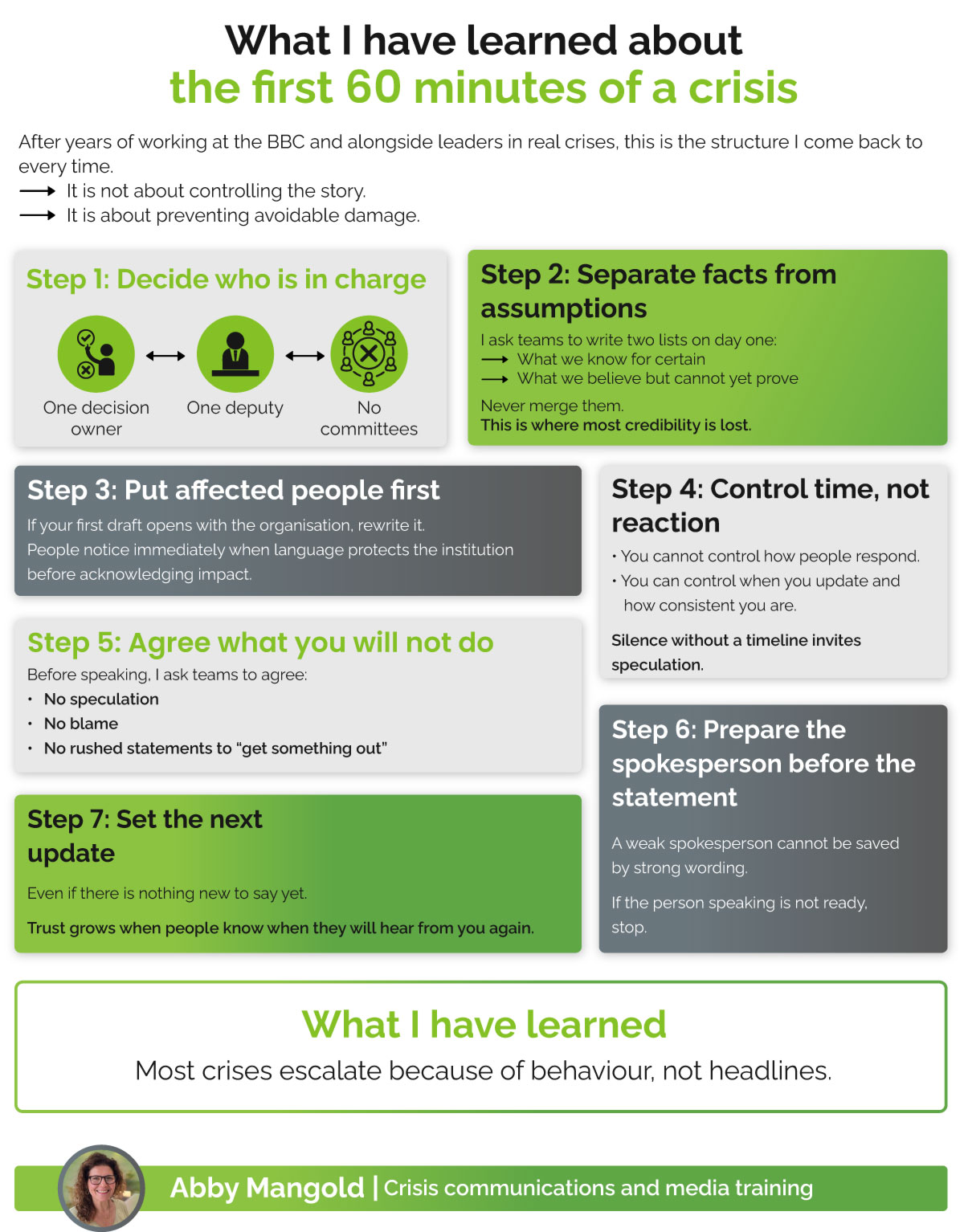
In a live crisis, this is the structure I come back to every time
Step 1: Decide who is in charge
- One decision owner
- One deputy
- No committees
Step 2: Separate facts from assumptions
I ask teams to write two lists on day one:
- What we know for certain
- What we believe but cannot yet prove
Never merge them. This is where most credibility is lost.
Step 3: Put affected people first
If your first draft opens with the organisation, rewrite it.
People notice immediately when language protects the institution before acknowledging impact.
Step 4: Control time, not reaction
- You cannot control how people respond.
- You can control when you update and how consistent you are.
Silence without a timeline invites speculation.
Step 5: Agree what you will not do
Before speaking, I ask teams to agree:
- No speculation
- No blame
- No rushed statements to “get something out”
Step 6: Prepare the spokesperson before the statement
A weak spokesperson cannot be saved by strong wording.
If the person speaking is not ready, stop.
Step 7: Set the next update
Even if there is nothing new to say yet. Trust grows when people know when they will hear from you again.
What I have learned: Most crises escalate because of behaviour, not headlines.