

Why crisis response today is about judgement over information

Abby Mangold presenting to a small team

One of the most dangerous assumptions I see in crisis response today is this:

That the truth will speak for itself (in the age of AI and fabricated content).

It will not.

I have learned that in moments of uncertainty, people do not wait for facts.

They look for signals.

  • Who speaks first.
  • Who sounds credible.
  • Who appears composed.
  • Who seems to care.

This is why crisis response today is less about information and more about judgement.

When deepfakes, edited clips and misinformation are circulating, the organisations that hold trust are the ones that already have three things in place.

First, decision discipline.

Someone who knows when to speak and when not to.

Not everything needs an immediate response, but everything needs a considered one.

Second, language that sounds human under pressure.

Audiences can sense scripted reassurance instantly.

In high-risk moments, tone matters as much as facts.

Third, leaders who have rehearsed uncertainty.

Not just the scenario, but the discomfort of not having all the answers.

What I have seen repeatedly is this:

Organisations do not fail because they lack technology, they fail because they have not prepared their people to lead when certainty disappears.

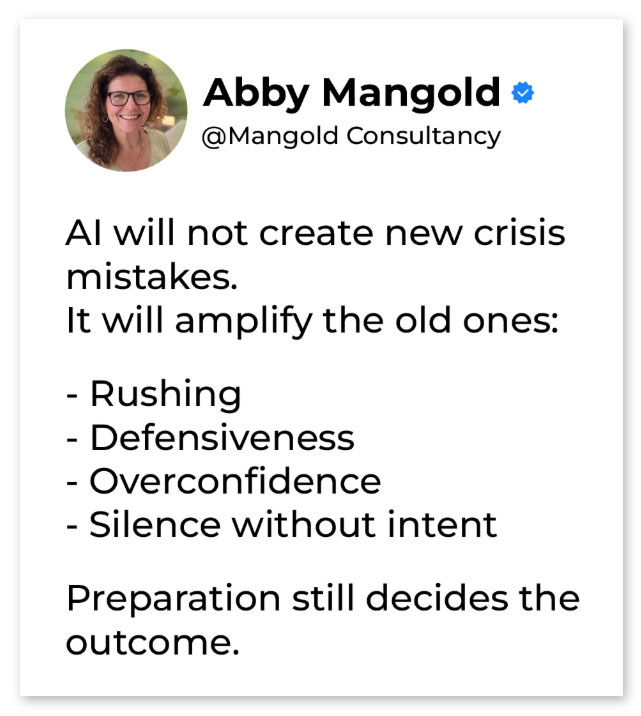
AI makes crises faster and noisier.

If you are relying on tools alone to protect trust, you are already exposed.

To ensure your team is ready for the digital challenges of today, explore our Social Media Crisis Management services.

The Social Media Crisis Checklist

Social Media Crisis Checklist

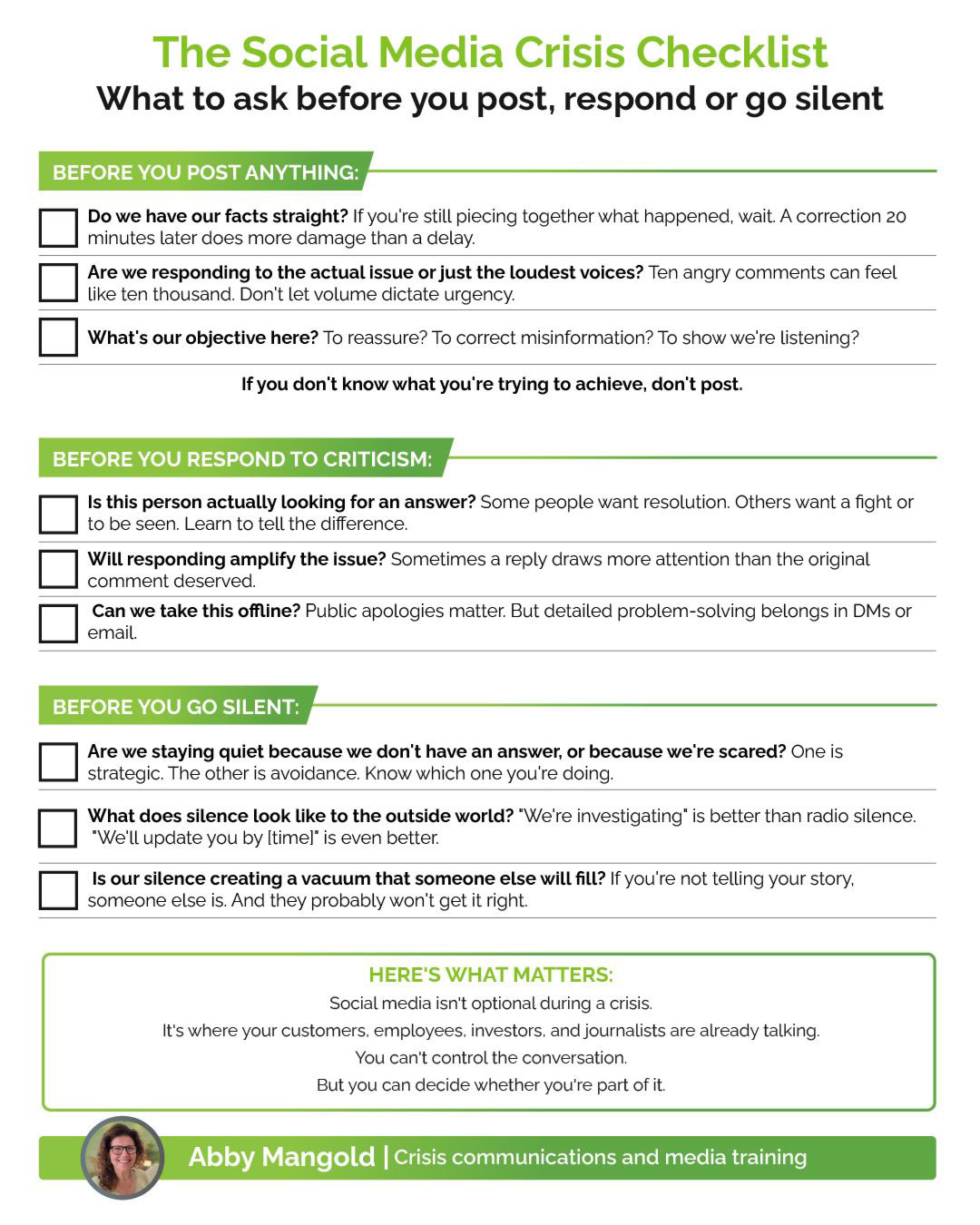
Please find below our Social Media Crisis Checklist.

Ignoring digital channels is a mistake. Effective social media crisis management ensures you control the narrative before others do it for you.

In the middle of a fast-moving situation, it is easy to feel overwhelmed by the sheer volume of comments and notifications. This social media crisis checklist is designed to help you pause, think, and act with intention rather than reacting out of fear.

A PDF version of the Social Media Crisis Checklist is available here »

Social Media Crisis Checklist

Why a structured approach matters

When a crisis breaks, the pressure to “say something” can be intense. We often see organisations rush to post a statement because they feel the need to keep up with the speed of the internet. However, being the first to speak is rarely as important as being the most accurate. If you put out information that you have to walk back 30 minutes later, you risk losing the trust of your audience at the exact moment you need it most.

Social media is not just a broadcast tool; it is a live conversation that happens whether you are in the room or not. By using the social media crisis checklist, you can move away from a defensive mindset and start managing the situation. It helps your team distinguish between a genuine customer who needs help and a vocal minority looking for a public disagreement.

Managing the silence

One of the hardest parts of a crisis is knowing what to do when you don’t yet have all the answers. While it is tempting to stay silent until the full picture is clear, radio silence often creates a vacuum. In that space, speculation and misinformation can grow.

A simple holding statement letting people know you are aware of the issue and stating when the next update will come is often enough to lower the temperature. It shows that you are present, listening, and taking the matter seriously.

If you are concerned about how your organisation would handle a crisis on social media, our team provides specialist support to help you manage the conversation and protect your reputation.

Why reputation risk for leaders moves fast online

Why reputation risk for leaders moves fast online

Did you see the viral clip from the US Open that captured global attention?

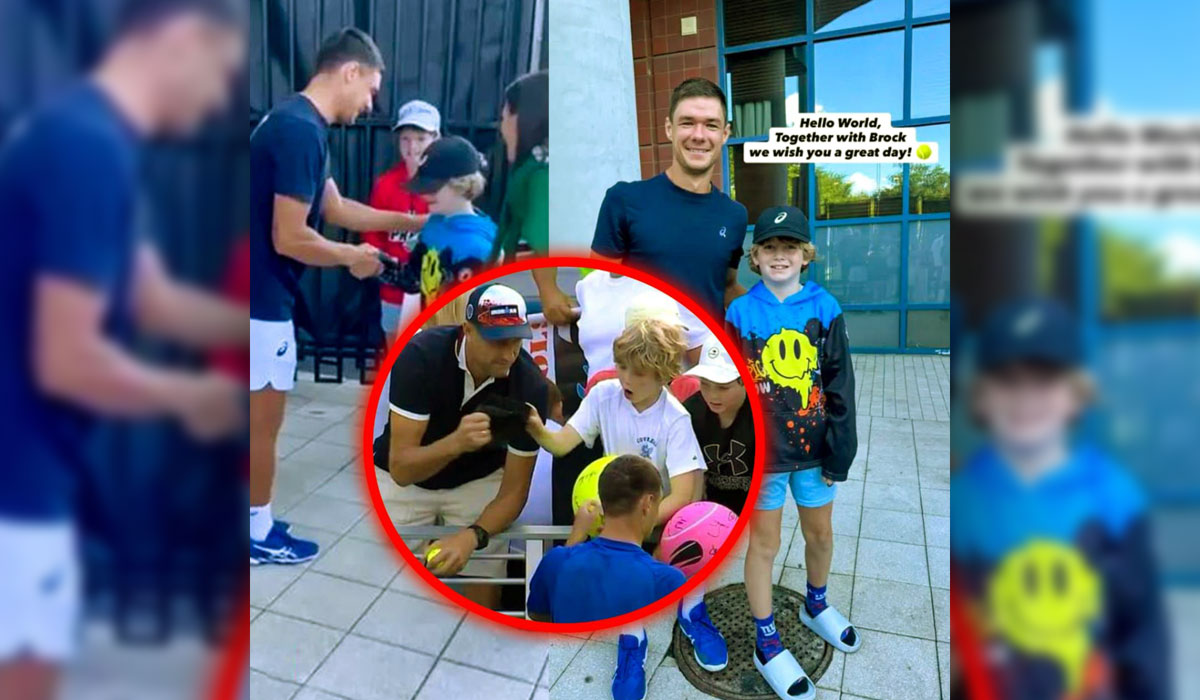
A Polish CEO (recently unmasked by the internet) was filmed snatching a hat from the hands of a young fan, as the tennis player Kamil Majchrzak signed autographs at the end of his match.
A moment that quickly became a flashpoint online.

As a parent, I cannot help but feel awful for the boy at the centre of this moment…what could have been a special memory has become a story of reputational damage and online outrage.

I was chuffed to see that the boy in question has since met with Kamil Majchrzak and got a replacement for the hat that was yanked from his hands.

The CEO in question has finally apologised and apparently deleted his social media. His company was flooded with negative google reviews and comments.

This is a powerful reminder that reputations are not shaped only by share price, strategy or statements but by how you act.

As a leader you ARE your brand.

In a world where a single moment travels far faster than context – how you behave speaks volumes – empathy, being human and behaving with decency are critical currency for leaders.


Millionaire snatches signed hat from child

There was no dead rat in the yogurt

Interview with Tom Mangold

Tom Mangold shares advice for spokespeople: be prepared, avoid jargon, rehearse key points and take responsibility in tough interviews.

“There was no dead rat in the yogurt.”

Thank you to everyone who suggested questions for veteran journalist, Tom Mangold.

Pretty proud of this one

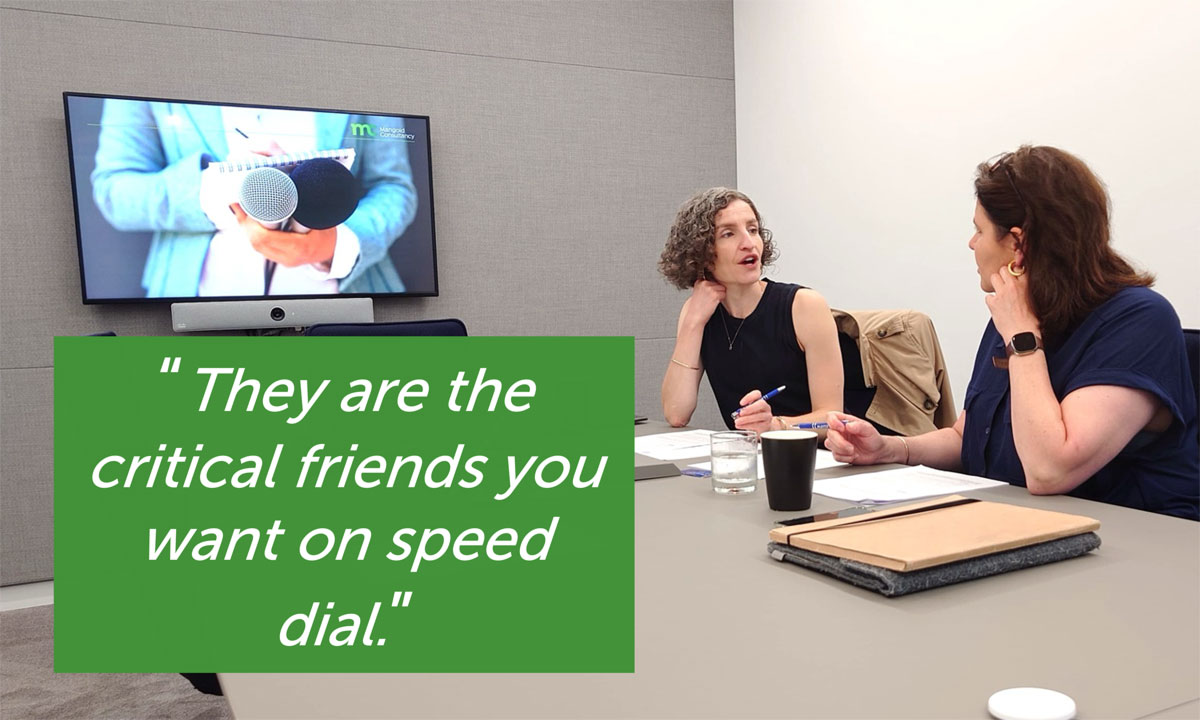
Pretty Proud: Abby Mangold & Jess Mangold: "They are the critical friends you want on speed dial"

We’ve been working with this retail client for 5 years.

We’ve gone through the good times and the tougher ones.

We’ve supported each other to grow as organisations.

So we were chuffed when they told us:

“Abby and Jess consistently provide clear thinking and boil down complex matters, into concise guidance.

As media trainers they are industry experts, give honest and fair feedback in a safe environment.

They are the critical friends you want on speed dial.”

Spoiler alert. Crises are nothing like disaster movies

Disaster Movie. Photo Credit:IGN

Spoiler alert. Crises are nothing like disaster movies.

Disasters (unlike the Rock) don’t fall out of the sky.

99% emerge from issues which have been bubbling for some time. People are aware and assume someone else will fix it or it will ‘just go away’.

Surprise – there are no silver bullets (or the Rock suddenly appearing to save the day). Solutions come step-by-step, from the A – Z of preparation and a tonne of hard work in ‘peacetime’.

Real heroes don’t look like Dwayne ‘The Rock’ Johnson. Well, some might but universally heroes are the people doing their jobs well, who know their organisation and have the empathy and communication skills needed to act in difficult situations.

Full transparency I’m a huge disaster movies fan (nothing to do with the Rock)

Photo Credit: IGN

Tom Mangold has worked in media for 70+ years – what would you ask him?

Abby & Tom Mangold

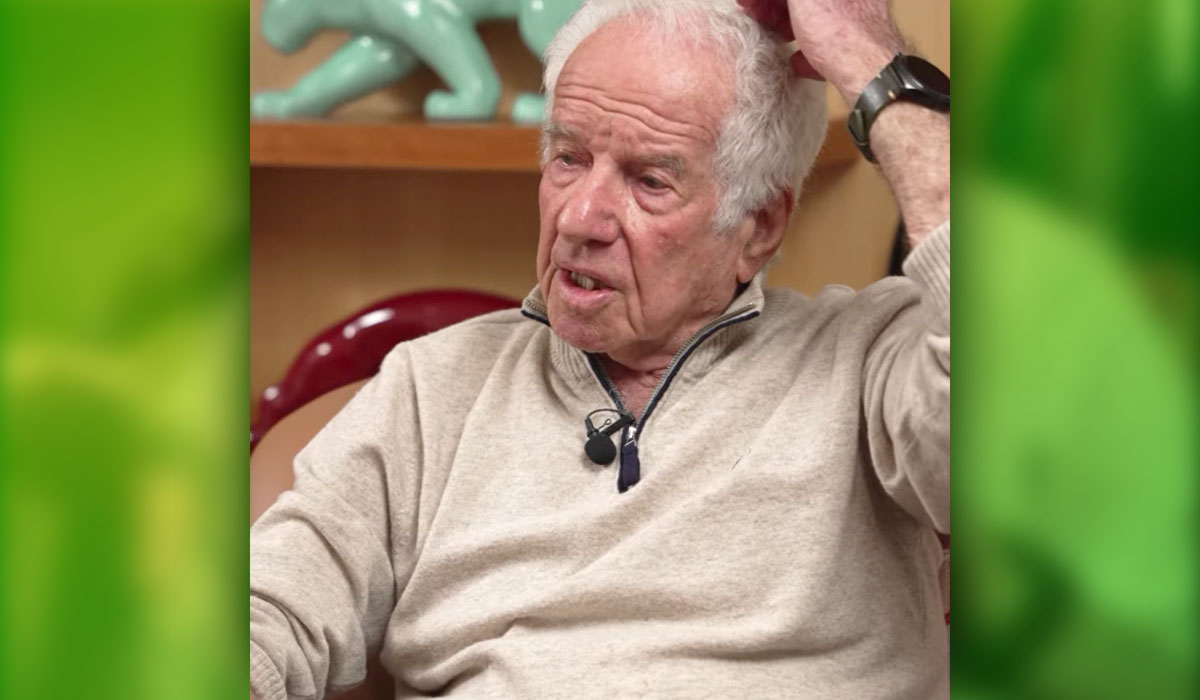
This is my Dad, Tom Mangold.

  • He’s an award-winning journalist and author.
  • Reporter on circa 120 episodes on BBC Panorama.
  • He’s 90 and STILL working.
  • He cycles every day.
  • He continues to inspire me and our work at Mangold Consultancy.

If you asked him, he’d tell you I stole everything I know from him. I will neither confirm nor deny this.

I’m going to film interview content with Dad and share it online.

We tend to talk about:

  • the state of journalism and television
  • crisis communications
  • media interviews
  • “news” on Social Media
  • rubbish spokespeople

Watch this space for unique insight from someone who has worked in the media industry for more than 70 years!

What keeps you awake at night?

What keeps you awake at night. Photo by cottonbro studio at Pexels

It is never easy asking people this question when you meet for the first time.

But tasked with writing the crisis communications guidelines for new clients, we have to take the plunge, so we know early on where they could be exposed from a reputational perspective.

4 years on from asking one client this question, we are their retained crisis communications agency, available 24/7 responding to calls, and working with the whole team to test and reinforce their crisis communications protocols.

Tough questions = good results.

Photo by cottonbro studio at Pexels

What is retained crisis communications support?

What is retained crisis communications support? Photo Vlad Deep at Unsplash

Our team is available 24/7, 365 days a year.

We are hands-on in a crisis: using 20+ years in national journalism, global crisis communications and social media expertise.

AND, if you remain crisis-free we use your retainer to grow team resilience, since any time not used for actual live crises goes toward preparation.

You can choose from

• workshops to assess reputational risks
• crisis simulations to test your team and processes in a safe space
• media training on camera
• social media management to handle challenges online

Retained crisis communications support = knowing you and your team are prepared for the unexpected.

Photo Vlad Deep at Unsplash

Learning to face the unexpected

Abby Mangold presenting to clients

Having worked on multiple crises, I now accept I will always face the unexpected.

And in the most serious crisis, even experienced ‘crisis mature’ teams need guidance. What do I remind them about?

The good – zero in on the basics, ensure up-to-date contact lists and access to all communication channels. With little notice small tasks make a big difference.

The bad – hone in on detail at the expense of the big picture. Details matter, nominate someone to confirm the specifics. You must assess the immediate impact of the crisis, while keeping the long-term reputational effects in clear view.

The ugly – collapse into a fit of jargon and industry speak at your peril. In a crisis people need to see people. Be human.

It’s 9pm on Saturday night, the phone rings, it’s work

It’s 9pm on Saturday night, the phone rings, it’s work

This can only mean one thing, bad news. Who do you call next?

In crisis management, timing is everything.

I well remember those late afternoon Friday calls to press offices, chasing a response to the story we were about to broadcast.

Everyone’s on the clock, press teams scramble to reply before the weekend, risking rushed comments and heightened media exposure.

But what if a crisis happens out of hours? Waiting until Monday morning is not an option.

That’s where retained crisis comms support comes in. It provides:

• 24/7 support to swiftly navigate crises and safeguard reputation

• Quicker decision making and strategy setting through established trusted relationships with senior leaders

• Proactivity to anticipate potential media scrutiny and the trajectory of the crisis

This is the unparalleled advantage of having a crisis comms agency on retainer.

Original photo by Quino Al on Unsplash

A critical friend

Critical Friend

A critical friend.

It’s the kind of friend, colleague and advisor I like to be.

It’s a balancing act advising CEOs when their business is under attack. Don’t say enough and you’re not worth the investment, push too hard and you can be seen as well….pushy.

So for me and Mangold Consultancy being a critical friend means being:
● straightforward by giving clear advice
● open and honest, even if it’s hard to hear
● invested in clients and their challenges, until issues are resolved

And when you look at it like that, it mirrors the relationships I have with friends too.

With special thanks to Ayesha Murray for being one of my very special and crucial critical friends.

The press doorstep – can you handle it?

The press doorstep - can you handle it?

Only watch this if you KNOW how to handle a doorstep*

The infamous doorstep only ends when the journalist leaves with something.

A no comment, a closed door, or in this case a response.

Managing a doorstep takes some well thought through choreography.

*Full disclosure, this one features my Dad, Tom Mangold, in action on BBC Panorama in 1997 so I may be biased.

The Post Office, Boohoo and the moments I miss investigative journalism

Investigative Journalism

It’s times like these that I miss making TV.

Watching Mr Bates vs the Post Office and the long overdue response from the Government I’m reminded about the power of TV and its reach – 9.2 million people watched the first episode, and that was before people started really talking about it.

Yes, there are lots of means to get publicity for your cause these days but there is nothing more convincing than real human stories, told well, through public service broadcasting.

Meanwhile, a BBC investigation has found that Boohoo put ‘Made in UK’ labels on clothes made overseas.

Ooooh to have been part of the team uncovering that little nugget.

These dramas and investigations take big teams of highly talented individuals, they take money (so lacking in journalism these days) and they take a collective will to ‘out the truth’ even when it can be months and years to gather the evidence you need.

My advice to any business on the receiving end of one of these investigations is take it seriously, if they’re coming for your response, they’ve already got the evidence they need and the truth, well the truth will always out, even if it takes 25 years.

What everyone must say and do in a crisis

Let's talk… warts and all…

In a crisis, being open and honest with each other is rule number one

Or as one client recently put it brilliantly – “Let’s talk, warts and all.”

Honesty defines how an organisation manages a crisis AND then how its people recover from the impact

Whether you create a safe space, share skeletons, speak up or speak out – always be honest.

Recharged for Autumn – bring it on

Jess & Abby Mangold are Recharged for Autumn - Bring on September!

Is it just me or does anyone else still get that beginning of term feeling?

The end of a holiday is never a highlight. But with plenty of behind the scenes Mangold Consultancy gubbins completed over the summer we are now rested and recharged for a busy Autumn.

Bring it on.

Crisis Communications Playbook

Crisis Communications Playbook

What do you do when you discover one of your employees has behaved inappropriately?
How do you respond when people challenge your business practices on social media?
What do you do when you get a customer complaint?
The list could go on.

Using experience and nous to assess and respond to live issues, based on the specific set of circumstances is absolutely the way to go in an emerging crisis.

Recently however, clients have asked us to compile a “playbook” of responses for the most frequent and reputationally damaging issues, after we’ve completed a reputational risk audit of their competitors and the wider sector.

A playbook is more than collating your “lines to take” or communications responses. Done well, this live document should become part of the Communications Team’s armoury with which you can effectively respond to issues as they develop. The playbook provides important insight such as :

  • stakeholders, reactions and patterns in their responses
  • social media activity including trends, keywords used and priority channels
  • topics which cause the most activity
  • duration of interest
  • key journalists
  • as well as the existing communications to help build a response

All too often the post-crisis sands of time slip away and soon the next issue is upon you. Taking time to stop and reflect on how you responded and what you can learn should be part of the ‘playbook’.

By taking a quick and thorough sweep of actions post-issue you will assess; did we get our message out there or are we just repeating the same old tired platitudes which don’t cut it with our customers / stakeholders.

Questions to ask post-event are:

  • did our last response achieve our objective
  • are our response times working
  • are the comms consistent with commitments made in the past
  • is now the time to review our corporate key messages to make them better reflect our current reality and after effects of an issue

Your playbook is the bible you refer to so the next time you’re challenged about the business, you approach it kitted up with knowledge from previous experiences as well as a starting form of words to use in response.

Background image by Joanna Kosinska , book composition by Studio JERO