

What I have learned about the first 60 minutes of a crisis

The first 60 minutes of a crisis

I am often asked what matters most in the first hour of a crisis.

  • Not the wording of the statement.
  • Not the headline.
  • Not the volume of coverage.

What matters is behaviour.

After years at the BBC and then working alongside leaders in live crisis situations, the first 60 minutes are where most avoidable damage either happens or is prevented.

  • Confusion about who makes decisions, fills gaps quickly.
  • Assumptions creep in when facts and unknowns aren’t separated early.
  • Language that protects the organisation before acknowledging impact is noticed immediately.

I’ve set out below the structure I return to when those first decisions matter most.

You can’t control reaction, but you can control consistency.

You can’t rush readiness.

And a strong statement won’t rescue a spokesperson who isn’t prepared to speak.

Most crises don’t escalate because of what’s reported.

They escalate because of what happens in that first hour, behind closed doors.

That’s the part I keep coming back to.

In a live crisis, this is the structure I come back to every time

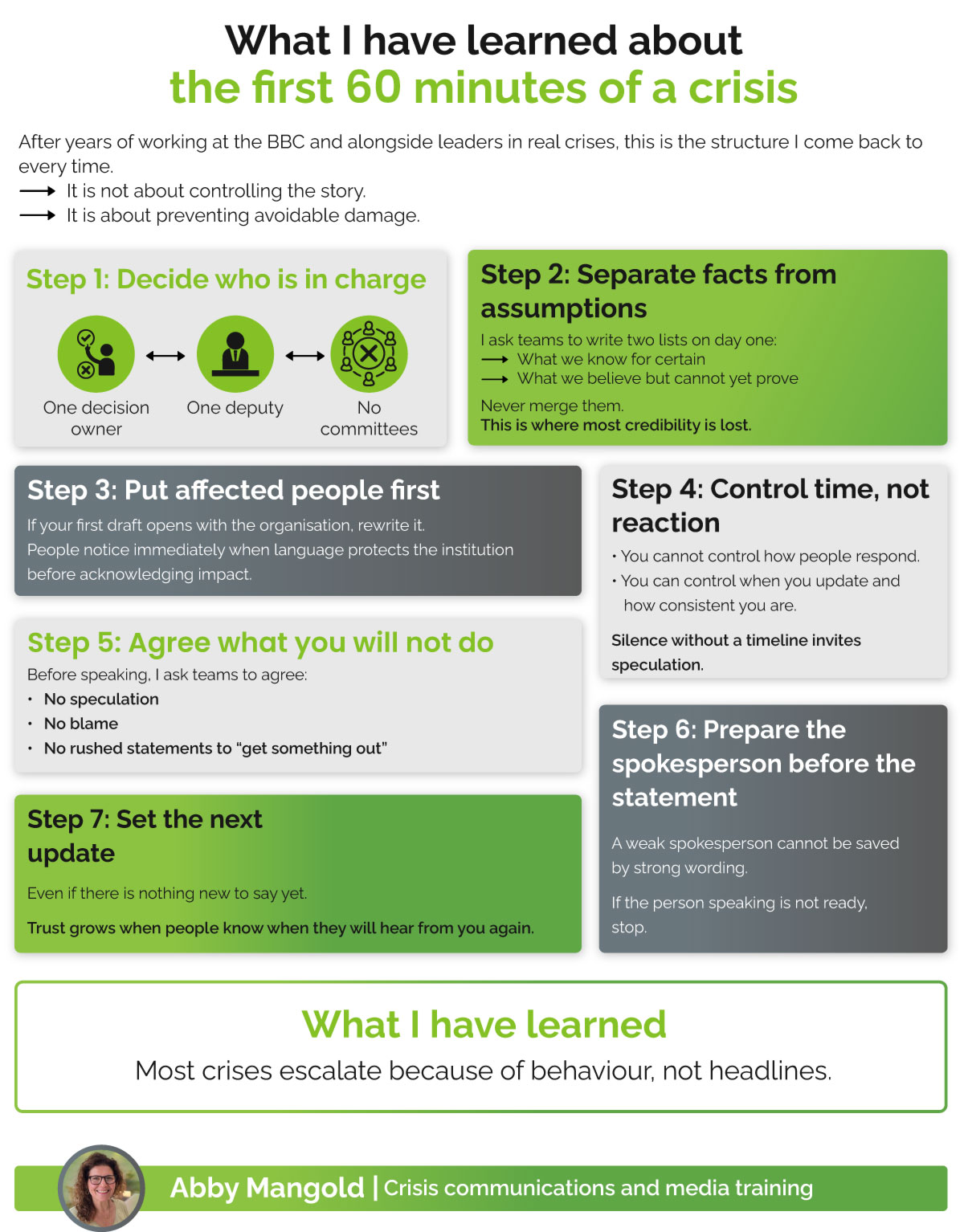
Step 1: Decide who is in charge

  • One decision owner
  • One deputy
  • No committees

Step 2: Separate facts from assumptions

I ask teams to write two lists on day one:

  • What we know for certain
  • What we believe but cannot yet prove

Never merge them. This is where most credibility is lost.

Step 3: Put affected people first

If your first draft opens with the organisation, rewrite it.
People notice immediately when language protects the institution before acknowledging impact.

Step 4: Control time, not reaction

  • You cannot control how people respond.
  • You can control when you update and how consistent you are.
    Silence without a timeline invites speculation.

Step 5: Agree what you will not do

Before speaking, I ask teams to agree:

  • No speculation
  • No blame
  • No rushed statements to “get something out”

Step 6: Prepare the spokesperson before the statement

A weak spokesperson cannot be saved by strong wording.
If the person speaking is not ready, stop.

Step 7: Set the next update

Even if there is nothing new to say yet. Trust grows when people know when they will hear from you again.

What I have learned:  Most crises escalate because of behaviour, not headlines.

Contact us to discuss how we can support your leadership team during the critical first 60 minutes of a crisis.

The first_60 minutes of a crisis


How to build an effective crisis response team

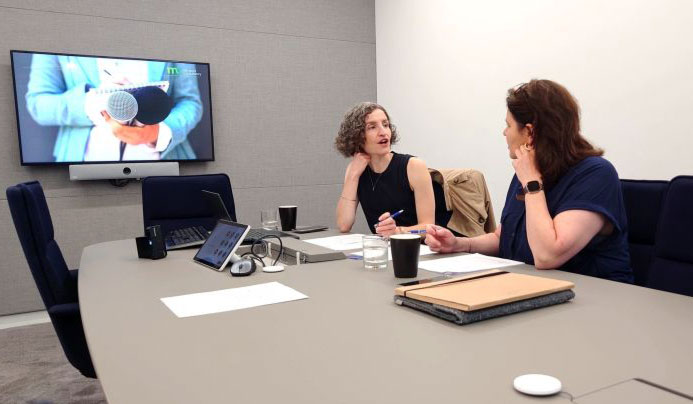
Abby Mangold and Jess Mangold in meeting

I’ve learned this the hard way: when a crisis hits, you find out very quickly who you can rely on.

Not by title.

Not by seniority.

But, by how people behave when the pressure becomes personal, before the answers become clear.

I’ve sat in rooms where decision making slowed because too many people needed to agree. I’ve seen strong legal advice help, and I’ve seen fear of getting it wrong quietly take control. I’ve watched credibility wobble when certainty was performed instead of earned.

Over time, you start to notice patterns.

Below, I’ve set out the working list I use when building or stress testing a crisis response team. It’s not theoretical. It’s shaped by what holds when timelines are tight, scrutiny is public and the margin for error feels small.

  • Calm matters.
  • Being able to say “we don’t know yet” matters.
  • Understanding how journalists think matters.
  • And so does having people in the room who are willing to challenge senior leaders when it counts. Titles don’t manage crises – People do.

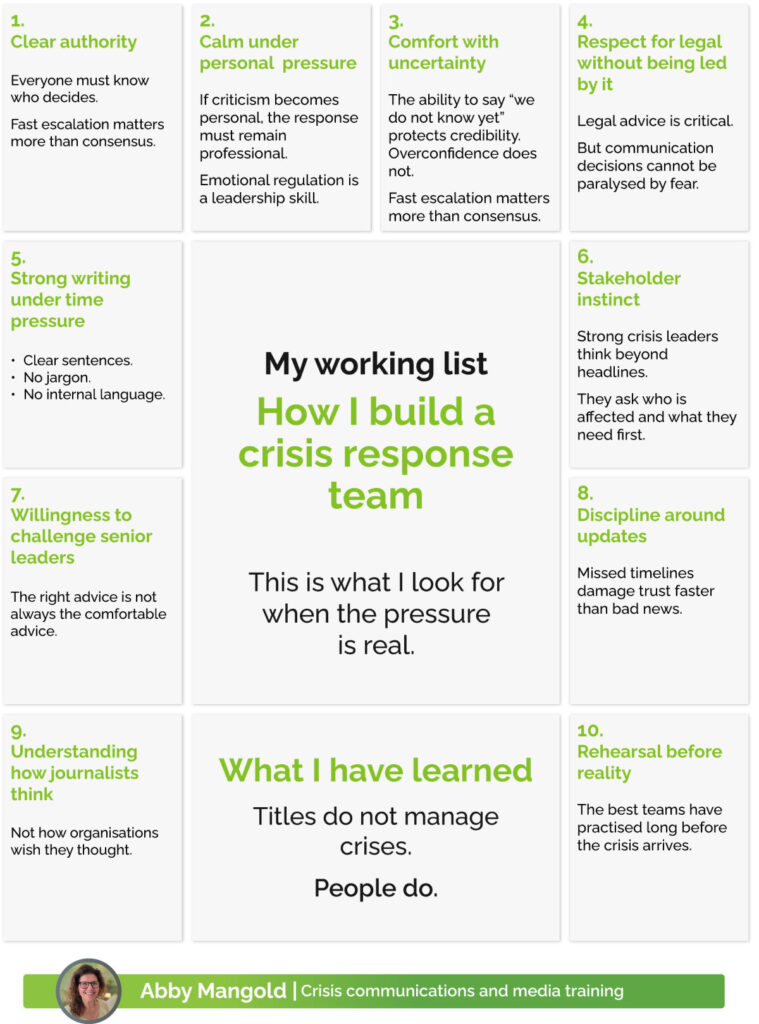
My working list: How I build a crisis response team

This is what I look for when the pressure is real.

1. Clear authority

Everyone must know who decides.
Fast escalation matters more than consensus.

2. Calm under personal pressure

If criticism becomes personal, the response must remain professional.
Emotional regulation is a leadership skill.

3. Comfort with uncertainty

The ability to say “we do not know yet” protects credibility.
Overconfidence does not.
Fast escalation matters more than consensus.

4. Respect for legal, without being led by it

Legal advice is critical. But communication decisions cannot be paralysed by fear.

5. Strong writing under time pressure

  • Clear sentences.
  • No jargon.
  • No internal language.

6. Stakeholder instinct

Strong crisis leaders think beyond headlines.

They ask who is affected and what they need first.

7. Willingness to challenge senior leaders.

The right advice is not always the comfortable advice.

8. Discipline around updates

Missed timelines damage trust faster than bad news.

9. Understanding how journalists think

Not how organisations wish they thought.

10. Rehearsal before reality

The best teams have practised long before the crisis arrives.


To learn more about stress-testing your internal response structures, visit our Crisis Planning and Preparation page.

How I build a crisis response team

3 Crises you won’t see coming (but should be ready for)

Most crises don’t begin with headlines.

They begin with silence.

With a decision made too quickly, or not at all.
With a message sent internally that spreads externally.

In today’s landscape, crisis comms isn’t just about knowing what to say when things go wrong.

It’s about seeing the warning signs that others miss.

I’ve outlined three crises I see organisations overlook again and again and what to do about
them.

Take a look through them. Then ask yourself, are we prepared for these?

If you’d like a Crisis Comms Prep Checklist I put together for leadership and comms teams, just message me. I’ll send it your way.

Because in a real crisis, you won’t have time to get ready. You either are or you aren’t.

3 Crises you won’t see coming (but should be ready for)

1. Silent Walkouts

  • You notice morale dipping.
  • Then key team members start to leave quietly

Tip: Early warning signs often show in silence, not complaints.

2. Algorithmic Discrimination

  • An AI tool unintentionally biases hiring decisions
  • The story becomes a reputational risk.

Tip: Your crisis plan must now include AI governance.

3. Values & Action Misalignment

  • The brand speaks on social impact.
  • But its partnerships suggest otherwise.

Tip: Audit your partnerships before someone else does.

Why These Go Unnoticed

They don’t feel like problems — until they become one.

By the time leadership is fully aware, the damage is already in motion.

Preparation starts with full risk awareness and clarity on what to do when issues surface.

Want to pressure test your crisis readiness?

I’ve created a Repuational Risk Tool for internal teams.

Get in touch if you’d like a copy.

Sometimes the best defence is having a plan you hope never to use.

The first hour crisis blueprint

first hour crisis blueprint

When the unexpected hits, the first 60 minutes decide everything.

In those moments, instinct kicks in but instinct without a plan can quickly unravel.

That’s why I run “first hour” drills with leadership teams.

We walk through what to do minute by minute: fact-checking, activating the right people, monitoring, and getting clear messages out fast.

It’s not theory. It’s practice.

Because in a real crisis, you don’t rise to the occasion you fall back on your training.

👉 Curious what that looks like? This is the blueprint I use to help leaders prepare.

The first hour crisis blueprint

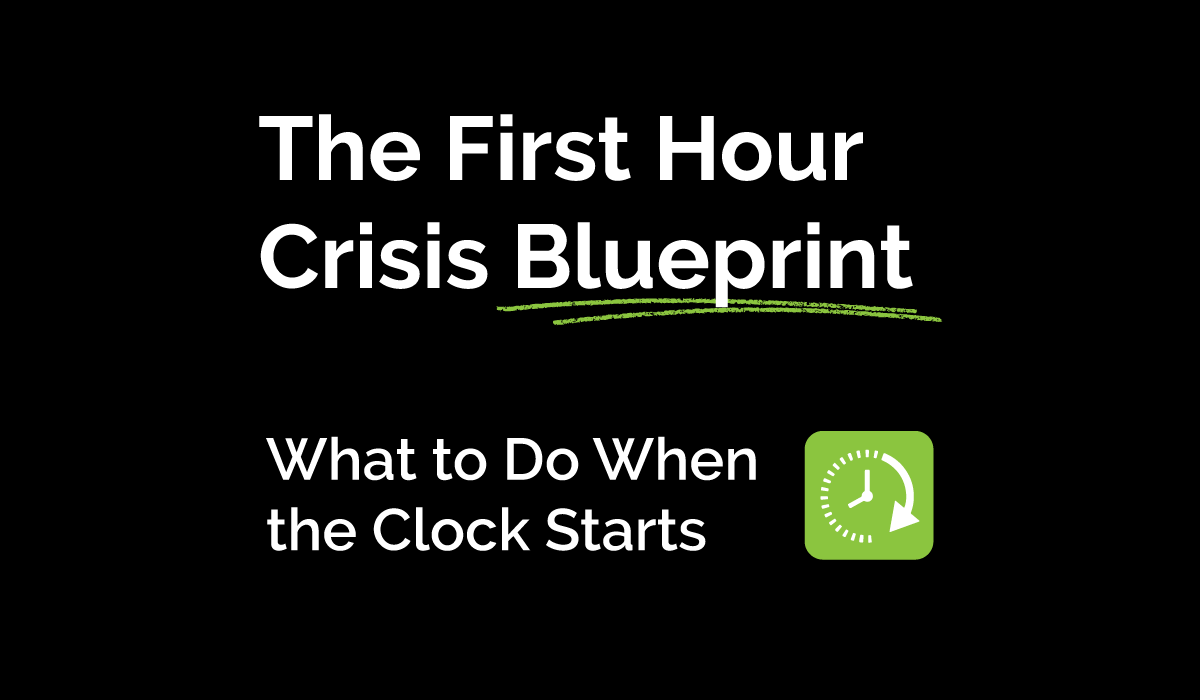
What to do when the clock starts…

  • 0–10 mins Check facts from source. No speculation
  • 10–20 mins Initiate Crisis Management team, brief Crisis Comms agency and switch on social media monitoring.
  • 20–30 mins Agree and issue holding statement.
  • 30–45 mins Draft follow up internal and external comms (concise, clear, calm).
  • 45–60 mins Issue updated comms.

Act Now Debrief later

Why AI reputational risks need cultural readiness

AI reputational risks

The biggest AI reputational risks I’m seeing inside organisations right now:

  • Deepfakes (external threat)
  • Biased or offensive AI outputs (internal threat)
  • Confidential data leaks via unsecured AI use (internal threat)
  • Misinformation amplified by AI (external threat)

I’ve advised leadership teams through all four in the last 12 months.

The fix isn’t just technical – it’s cultural and procedural.

Every team, from comms to legal to IT, needs to know their role before it happens.

Why crisis communication readiness protects reputation

Crisis communication readiness with Mangold Consultancy.

In 80% of crises I handle, the damage isn’t caused by the event itself

It is caused by what is said or not said in the first 24 hours.

I have seen small incidents spiral into national headlines because leaders guessed their way through the response.

I have also seen major crises vanish from public conversation in days because the messaging was prepared in advance.

Crisis communication is not spin.

  • It is readiness.
  • It is knowing what to say before you have to say it.

If you want that level of readiness for your organisation, we should talk now, not when the crisis has already arrived.

Why reputation in crisis communications matters

Reputation in crisis communications - you don't need to go viral

You don’t need to go viral

You need to stay credible.

The next headline won’t care how many views your last post got.

What matters is

  • Can you be trusted?
  • Are you consistent?
  • Will people believe you when it counts?

A tech founder I worked with had all the right metrics online. But when their product failed and the media called they froze.

The polish cracked. The trust dropped.

In crisis comms, reach is nice. But reputation is everything.

Build that. And everything else follows.

Why crisis leadership is not always about the job title

In a crisis, leadership is not always about the job title

After following my son onto a roller coaster, I realised something about crisis leadership.

I have led crisis teams through events watched by millions.

I have guided CEOs through live interviews knowing the wrong phrase could cost them everything.

But on a rollercoaster in Florida, my youngest son was the leader.

I just followed.

It reminded me that in a crisis, leadership is not always about the job title.

It is about the person with the calm, clear head when everything feels like it is going off the rails.

I have been that person in the middle of breaking news and corporate storms.

It is why organisations keep me close before they need me.

If you do not have someone like that in your corner, you are leaving it to chance.

And chance is not a strategy.

The one question that shapes every crisis communication strategy

There’s one question I’ve asked in dozens of boardrooms, training rooms and crisis management rooms over the years.

No matter the sector, the size of the organisation or the titles in the room – it always changes the energy.

I usually wait for the right moment. The conversation is flowing. People are confident. They think they’re prepared.

Then I ask it.

“What’s the one thing you’ve not told me that you hope no one ever finds out?”

It’s not about digging for secrets. It’s about surfacing risk. Because that’s usually where the real vulnerability lives and where the real comms work begins.

You cannot build a credible crisis comms strategy without being truly honest about what would do the real damage, if revealed.

That one question has shaped entire strategies. It has revealed gaps, rebuilt trust and prepared teams for headlines they never thought they’d face.

What’s the hardest question you’ve ever had to ask a client or a leader? I’d love to hear.

At Mangold Consultancy we help teams prepare for crisis situations through practical communication training. Get in touch to find out more

5 Lessons from Senior Business Execs to make you a better leader

Lessons from senior business leaders

Tips from media interviews with Senior Business Leaders: a year of learning in the virtual room

Global Media and Entertainment; Health, Sports and Fitness; High Street Brands, City Law Firms and Entrepreneurs. Over the last 12 months we’ve trained senior leaders from some of the world’s biggest and most successful brands.

When we pivoted to virtual media training, we never imagined the roll call of people we would work with. And yet a year on, we have had a privileged and unique insight into a diverse roster of senior leaders from many industries.

Continue reading “5 Lessons from Senior Business Execs to make you a better leader”