
5 critical gaps boards miss in crisis preparation

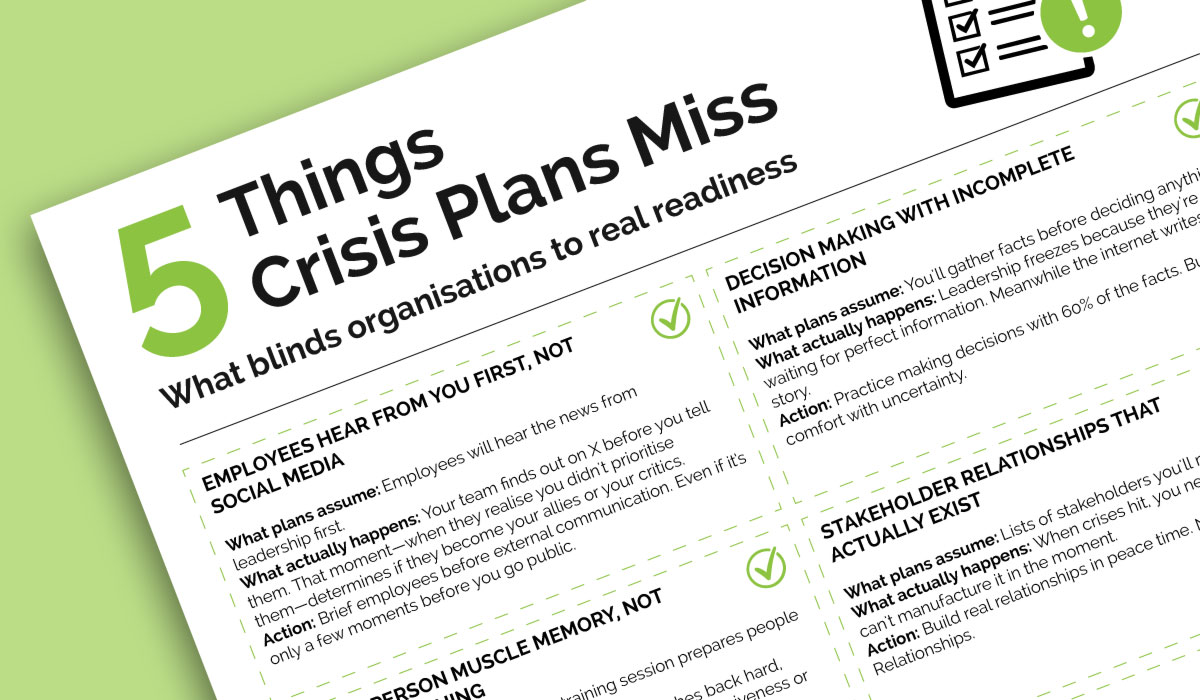
5 Things Crisis Plans Miss

I’ve done a lot of work this year with boards on crisis preparation and management. And I’ve started to notice something consistent: the things they’re worried about and the things that actually matter in a crisis are often different.

Most boards have documentation. Clear plans. Detailed scenarios. They’ve put real thought into this. But there’s usually a gap between what’s on paper and what actually happens when pressure comes.

It’s not that the plans are bad. It’s just that certain things don’t get included because they’re harder to document. They’re messier. They require something different than writing a strategy. It’s almost as if boards are scared to put them on paper.

Over the years, I’ve seen boards miss the same five things. Repeatedly. And when I point them out, it’s a lightbulb moment..

Here’s what I’ve learned. Not to criticise what’s already been built. But because knowing the gap exists means you can actually do something about it.
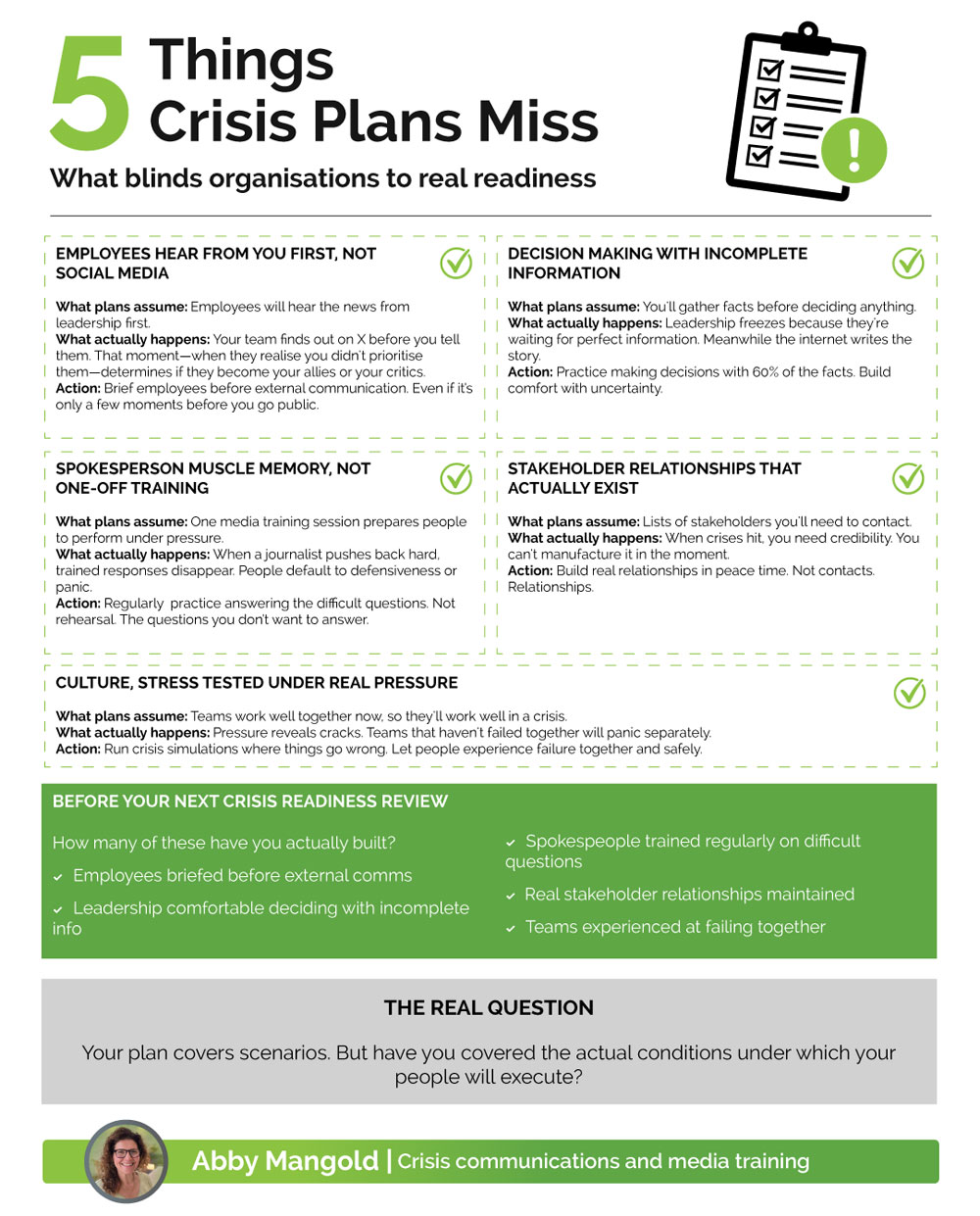
5 Things Crisis Plans Miss

If you want to bridge the gap between what is written on paper and how your leadership team performs under pressure, find out how our crisis planning and preparation services can support you.

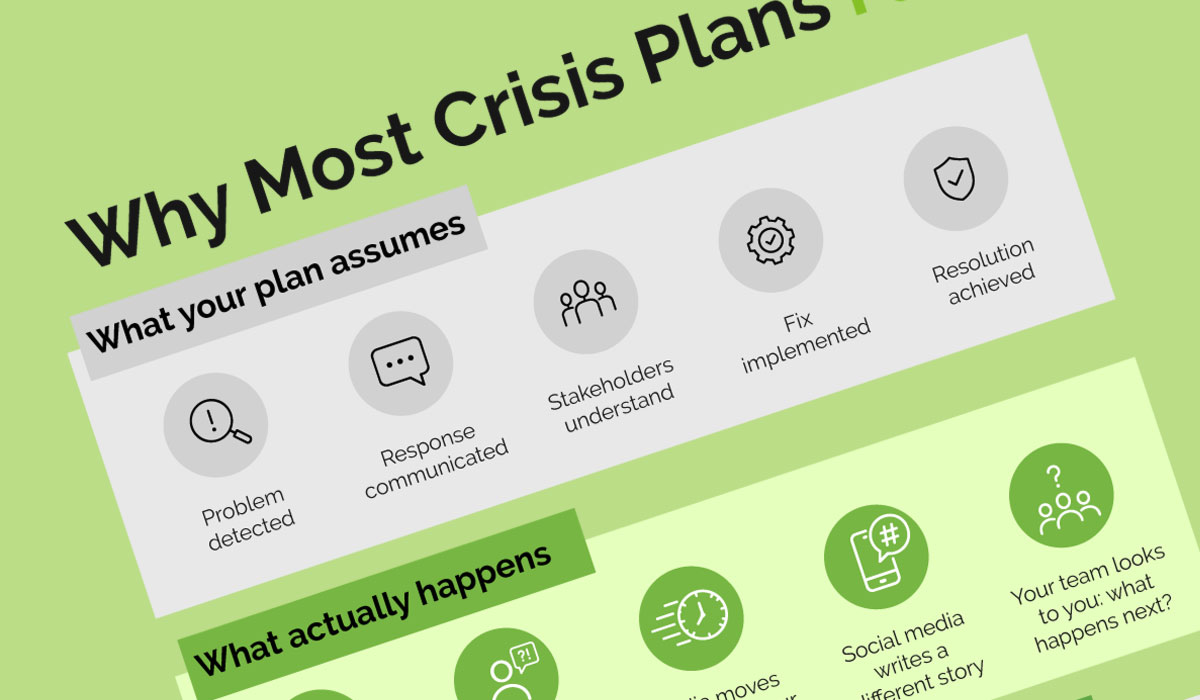
Crisis communication preparation is the person, not the document

Crisis Preparation Is The Person, Not The Document

After 15 years working in crisis communications, I still don’t understand why organisations get their crisis communication strategy so fundamentally wrong.

They spend weeks perfecting their crisis communication strategy. Assigning roles, mapping scenarios, documenting responses. The plan looks brilliant on paper.

Then something real happens and teams freeze. Not because the plan failed. Because they don’t actually trust each other when everything is moving fast.

I’ve watched crises unfold exactly as predicted in the document. Step by step, scenario covered, everything accounted for.

But if your team doesn’t know how decisions get made under pressure, if people haven’t practised being honest when the information is incomplete, if transparency isn’t already a habit the plan is just a document sitting in a folder.

Your board can have the perfect strategy. But strategy doesn’t execute itself. People do. And people only execute under pressure if they already trust each other and believe their leadership means what they’re saying.

The organisations that come through crises stronger don’t have better plans.

They have teams that already know how to work together when it matters.
Preparation is the person, not the document.

If you want to move beyond paper documents and prepare your leadership team to act with confidence under pressure, learn more about our crisis planning and preparation services.

Why your crisis communications plan will fail under pressure

Why your crisis communications plan will fail under pressure

Most organisations have a crisis communications plan that sits in a folder.

It covers scenarios, assigns roles, details responses. Then something real happens and they discover it was written for a different crisis entirely.

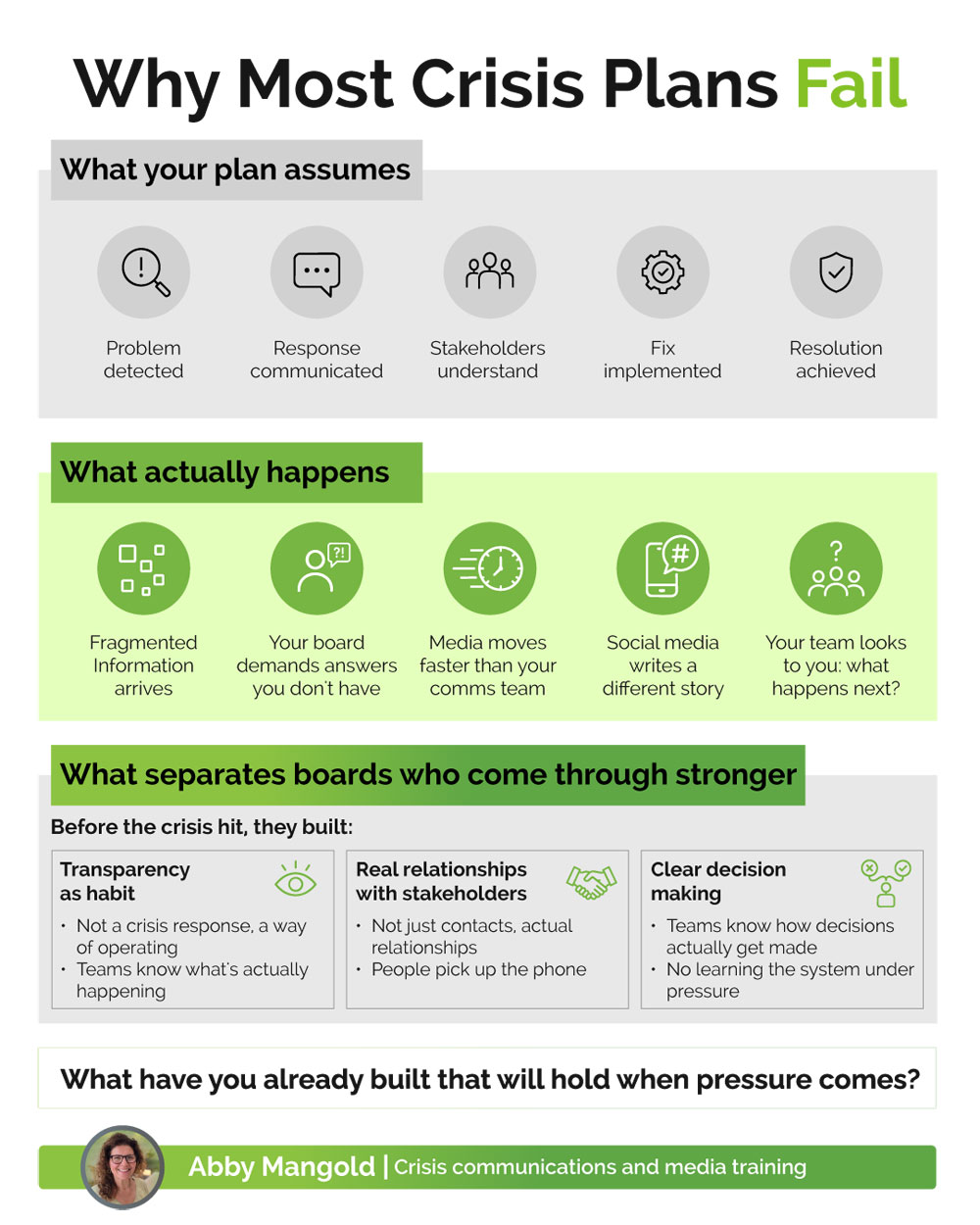
Here’s what I’ve observed: the boards who handle crises better don’t have better plans. They have built something long before the crisis arrives.

Transparency as an actual habit, not a response mechanism. Real relationships with stakeholders, not just contact lists. Clear decision-making processes their teams understand, because they’ve watched them operate in normal times.

When pressure comes, those teams don’t waste energy wondering if leadership believes what they’re saying. They don’t have to learn the system under crisis conditions. They move because the infrastructure is already there.

The boards that struggled had built all the tactical components. They had the right roles assigned, the right channels identified. What they hadn’t built was trust.

When the crisis hit, their teams didn’t know if leadership meant what they were saying. That uncertainty travelled faster than any communication could fix.

Preparation is the person, not the document. What have you actually built before the crisis that will hold when pressure comes?

Why your crisis communications plan will fail under pressure

If you want to ensure your organisation relies on real operational readiness rather than just a document on a shelf, discover how our crisis planning and preparation services can support your leadership team.

When misinformation gets ahead of your crisis response

When misinformation gets ahead of your crisis response

The lie spreads faster than the truth. And most crisis response plans still don’t account for it.

Something goes wrong. The organisation starts gathering facts, preparing a crisis response, checking legal, getting sign-off.

Whilst they’re doing that, someone posts their version of what happened. It’s wrong. Or partly wrong. Or missing context.

But it’s out there. And it spreads.

By the time the organisation releases their statement with the actual facts, thousands of people have already seen the false version. They’ve shared it.

They’ve formed an opinion based on it.

Now you’re not just managing the crisis. You’re fighting misinformation.

I’ve seen organisations spend more time correcting what didn’t happen than explaining what did. Entire crisis responses shaped by having to push back against false narratives instead of addressing the real issue.

The problem is speed. Misinformation moves fast. It doesn’t need to be checked. It doesn’t need sign-off. Someone sees something, makes an assumption, posts it. Done.

Your official response needs legal review, fact-checking, executive approval. By the time it’s ready, you’re already behind.

And here’s what makes it worse: correcting misinformation often amplifies it.

You issue a statement saying “reports of X are false” and now more people know about X.

Most crisis communication training doesn’t account for this. It assumes you control the narrative if you respond quickly and clearly.

You don’t. Not anymore.

The organisations that handle this well do two things.

  1. They monitor what’s being said in real time not just traditional media, but Reddit, X, wherever their crisis is actually playing out. And they respond directly in those spaces, not just through official channels.
  2. That feels uncomfortable. It means engaging with rumours before you have perfect information. It means responding in places where you can’t control the message.

But if you wait for perfect information, the misinformation wins.

The crisis isn’t just what happened. It’s what people believe happened. And if you’re not actively shaping that, someone else will.

If false narratives or social media speculation are moving faster than your team can respond, explore our social media crisis management services to see how we can help you stay ahead.

Understanding crisis communication from a journalist’s perspective

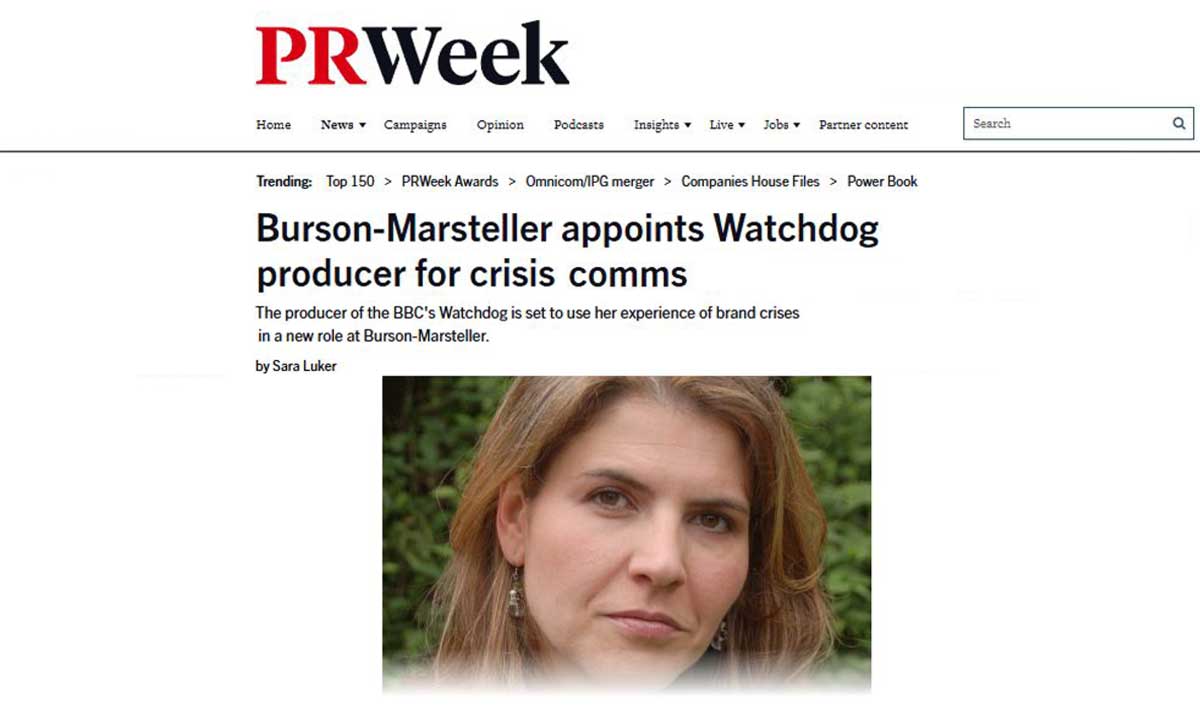
PR Week - Burson Marsteller appoints Watchdog producer for crisis comms

Year: 2012. When I made the jump from BBC to crisis communications.

15 years producing undercover investigations for programmes like Watchdog taught me how journalists think, how they work and what they’re looking for when they ask questions.

That’s the foundation of everything I do now. Training spokespeople isn’t about teaching them to dodge questions, it’s about understanding what’s coming and being prepared for it.

The best crisis communicators I work with think like journalists. They know what the story is before the reporter does. They anticipate the follow-up questions. They understand what will get used and what won’t.

That doesn’t come from reading a media training handbook. It comes from knowing how the other side operates.

I’ve now run Mangold Consultancy for over a decade, but this is still where it all started: understanding crisis communication from the journalist’s perspective first.

If you’d like your spokespeople to think the way journalists do, not just prepare for them, get in touch to find out how our media training works, or learn more about the team behind Mangold Consultancy.

Join the discussion on LinkedIn »

Why the wait and see approach is a dangerous crisis strategy

Abby Mangold Working with small team

“Let’s wait and see if this becomes a problem before we respond.”

I’ve heard this line in a few crisis meetings.

And every single time, it’s the wrong call.

Because by the time you know it’s a problem, it’s already a bigger problem than it needed to be.

Here’s what actually happens when organisations “wait and see.”

  • Hour one: A story appears. It’s small. Manageable. You decide to monitor it.
  • Hour three: It’s been shared a few hundred times. Still not major. “Let’s see where this goes.”
  • Hour six: A journalist has called. Someone in your team has said “no comment” because nobody briefed them on what to say.
  • Hour twelve: The silence is now the story. Your competitors are being asked to comment on your situation.
  • Day two: You finally issue a statement. It’s good. It’s measured. It’s completely irrelevant because everyone has already decided what this means.

The problem with “wait and see” is that it assumes doing nothing is neutral. It’s not.

Silence is a decision. And in a crisis, it’s usually the wrong one.

I’m not saying you need a full statement in hour one.

But you do need a position. And you need your people to know what it is before a journalist calls and puts them on the spot.

The organisations that manage crises well aren’t the ones with perfect statements.

They’re the ones who have a strategy, made a decision early and stuck to it.

“Wait and see” isn’t caution.

It’s just hoping it goes away.

It won’t.

Being proactive is the key to successful reputation management. If you want to move beyond a “wait and see” culture and develop a robust response plan, explore our crisis planning and preparation services.

How to know if you and your team actually need media training

Mangold Consultancy Media Training

Someone asked me recently: “How do I know if we actually need media training?”

Fair question.

Because most organisations don’t think about media training until they need it urgently. Which is usually too late to prepare properly.

So here’s my answer.

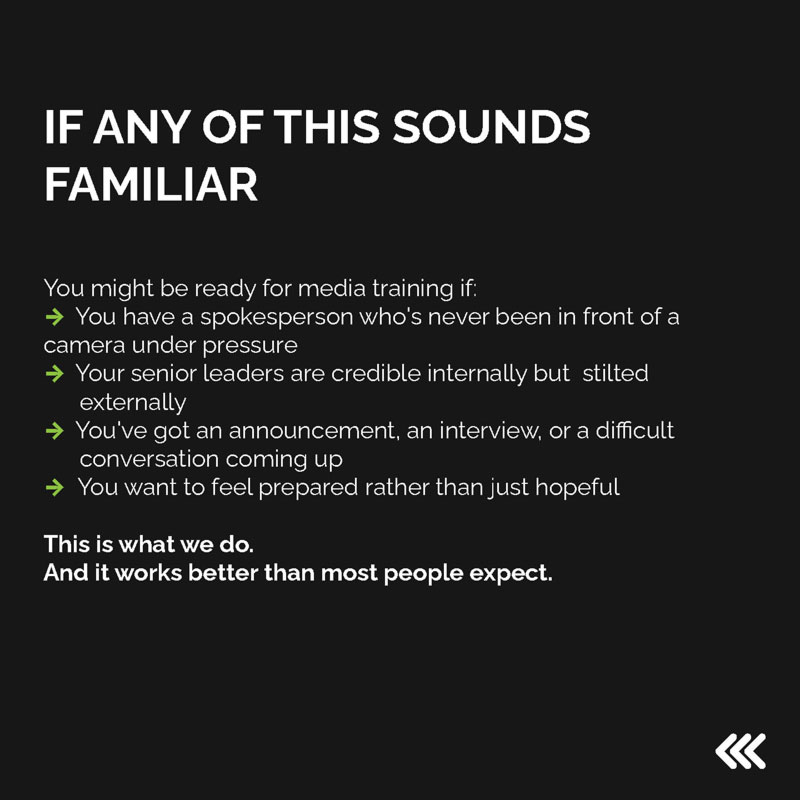
You probably need media training if any of these sound familiar:

  • Your CEO is brilliant in the boardroom but has never been on camera.
  • You’ve got a big announcement coming up and nobody has rehearsed how to talk about it under pressure.
  • Your senior team keeps saying “we should probably do some training” but it never quite happens.
  • You’ve got spokespeople who are technically expert but go blank the moment a microphone appears.
  • Someone is about to do their first major interview and you’re crossing your fingers rather than feeling confident.
  • You’re preparing for something difficult – a restructure, an incident, a sensitive topic and you know the questions are going to be uncomfortable.

If any of these sound familiar, you’re already later than you should be.

Not catastrophically late. Just late enough that it’s worth sorting now rather than waiting until it becomes urgent.

Because the difference between a spokesperson who has practised under pressure and one who hasn’t is immediately obvious.

To them. To you. To everyone watching.
The work isn’t complicated.

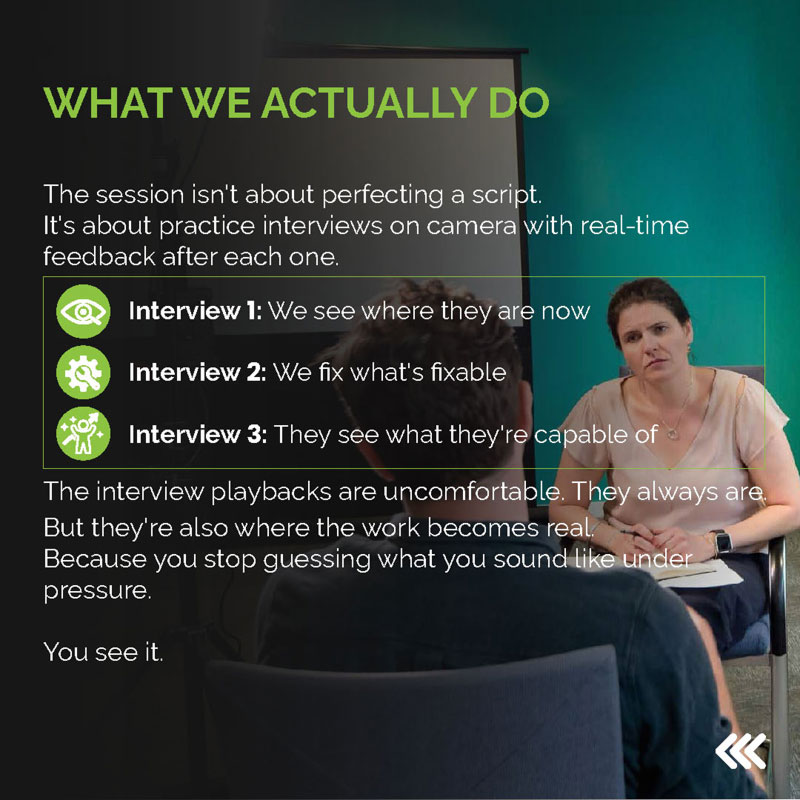
We put people in front of a camera. We ask them difficult questions. We watch it back together. We fix what’s fixable.

By the end of the day, they’ve seen themselves do it. And that’s what builds confidence – not being told they’ll be fine, but watching themselves actually do it.

If you’re in that position where you know someone needs to be ready and you’re not entirely sure they are, that’s what we do.

Worth sorting before it becomes urgent.

The best time to prepare for a media interview is before the request arrives. If you want to ensure your leaders are confident and ready for the camera, find out more about our media training and presentation skills.

How to handle difficult questions and avoid media traps

How to handle difficult questions

15 years at the BBC taught me something most spokespeople never learn: difficult questions are often only challenging because of how they are structured.

Journalists use the same question types over and over again. Once you recognise the pattern, you can see where they’re heading before they finish the sentence.

And that changes everything about how you prepare.

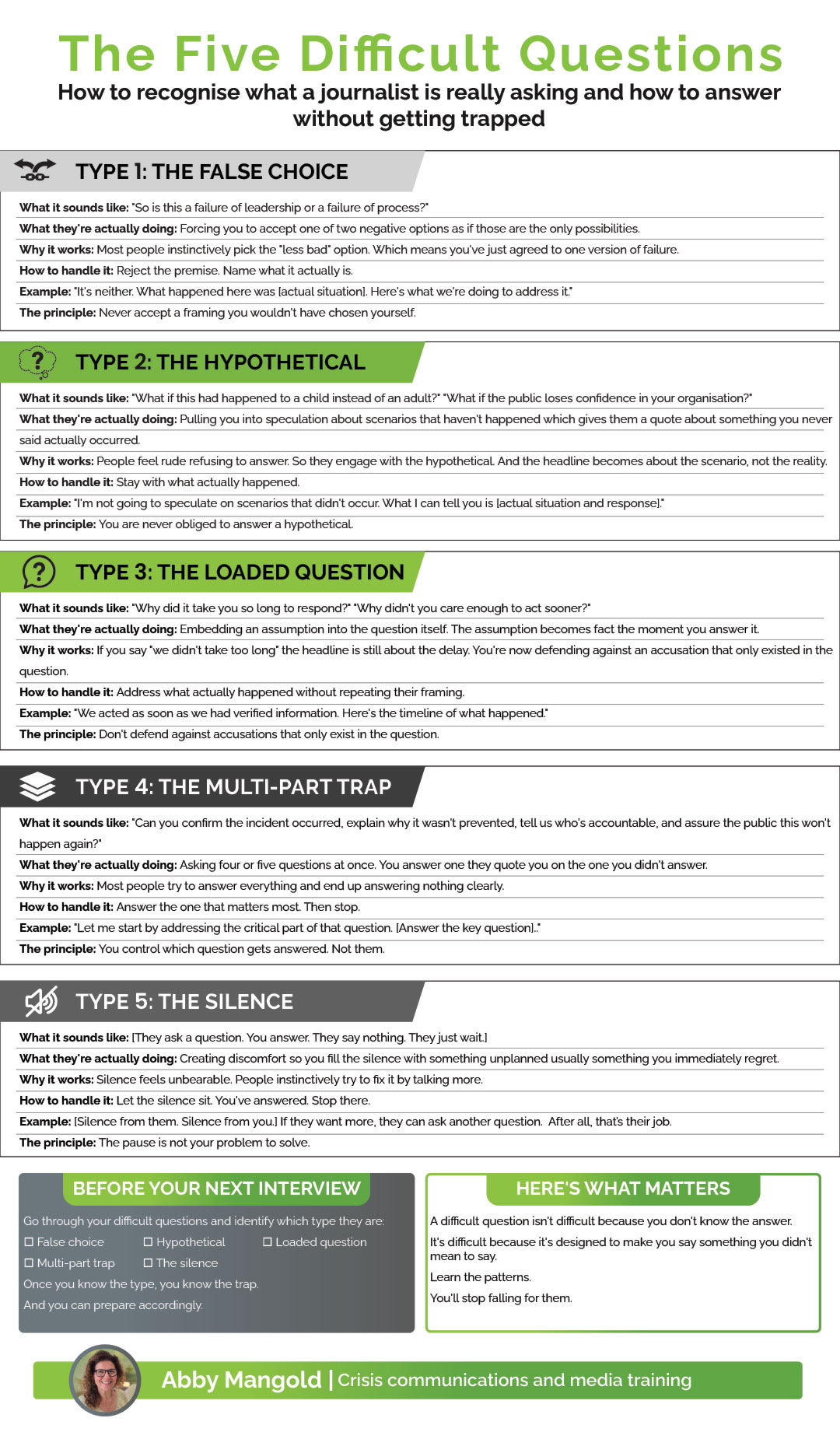
I’ve mapped out the 5 most common difficult questions, the ones that catch spokespeople out every single time.

Learn to spot these and you’ll stop walking into traps you didn’t see coming.

The five difficult questions

Recognising the pattern of a question is the first step toward a successful interview. If you want to practise handling the toughest enquiries in a safe environment, find out more about our media training sessions.

Why you should stop using filler language in a crisis statement

AI reputational risks

“We take this very seriously.” If I had a pound for every time I’ve read that sentence in a crisis statement, I could retire.

It appears in almost every apology. Every incident response. Every difficult announcement.

And it means absolutely nothing.

Because of course you take it seriously.

Nobody issues a statement saying “we’re treating this with complete indifference.”

The phrase exists to fill space whilst saying nothing at all.

What people actually want to know is not whether you’re taking it seriously.

They want to know what you’re doing about it.

Specifically. With timelines.

  • “We’re reviewing the incident” tells me nothing.
  • “We’ve suspended the individual involved and launched an independent review, which will report findings by the end of March” tells me everything.

One sounds serious.

The other is actually serious.

I understand why the phrase keeps appearing. It feels safe. It sounds concerned. It’s hard for anyone to argue with.

But that’s exactly the problem.

It’s designed not to be argued with which means it’s also designed not to mean anything.

The organisations I work with who get crisis communications right have learned to stop using placeholder language entirely.

They’ve realised that the gap between “we’re taking this seriously” and “here’s exactly what we’re doing” is the gap between managing a crisis and prolonging one.

Strip out the filler.

Say what you’re actually doing.

The rest is just noise.

Vague language can prolong a crisis rather than resolve it. If you need help drafting clear, impactful communications that protect your reputation, explore our crisis management services.

Are our people ready? Why practical preparation is vital for spokespeople

Abby Mangold of Mangold Consultancy

I’ve been doing this work for over 25 years now, and the conversations I have with new clients almost always start with the same question: “Are our people ready?”

They ring because something is happening or about to happen that needs a spokesperson.

  • A product launch.
  • A difficult announcement.
  • An interview opportunity.
  • Sometimes a crisis that’s already started.

And the underlying question is always: “Are our people ready for this?”

Not “do they have the key messages.”

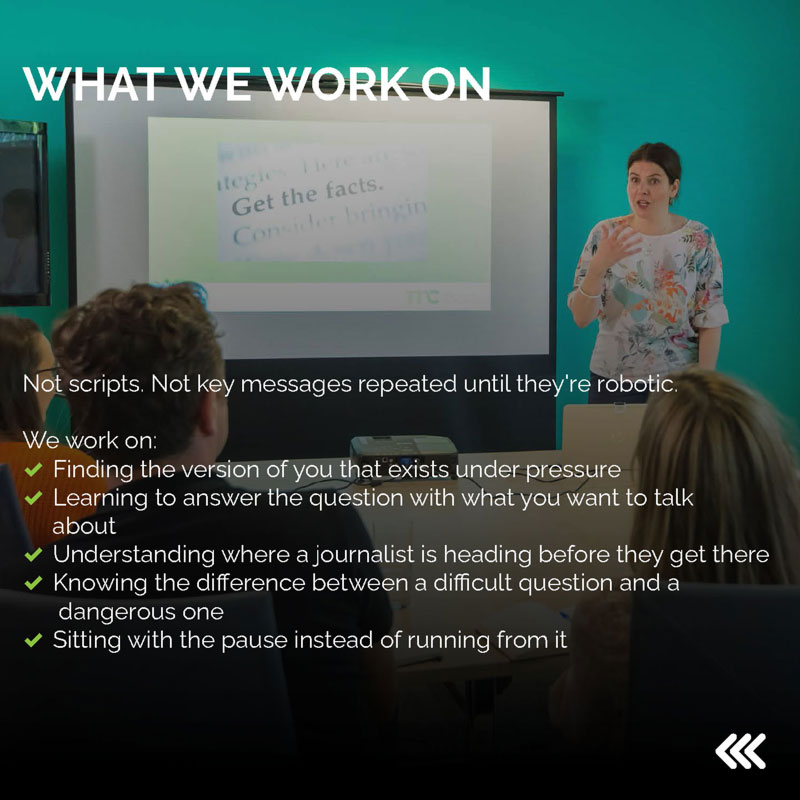
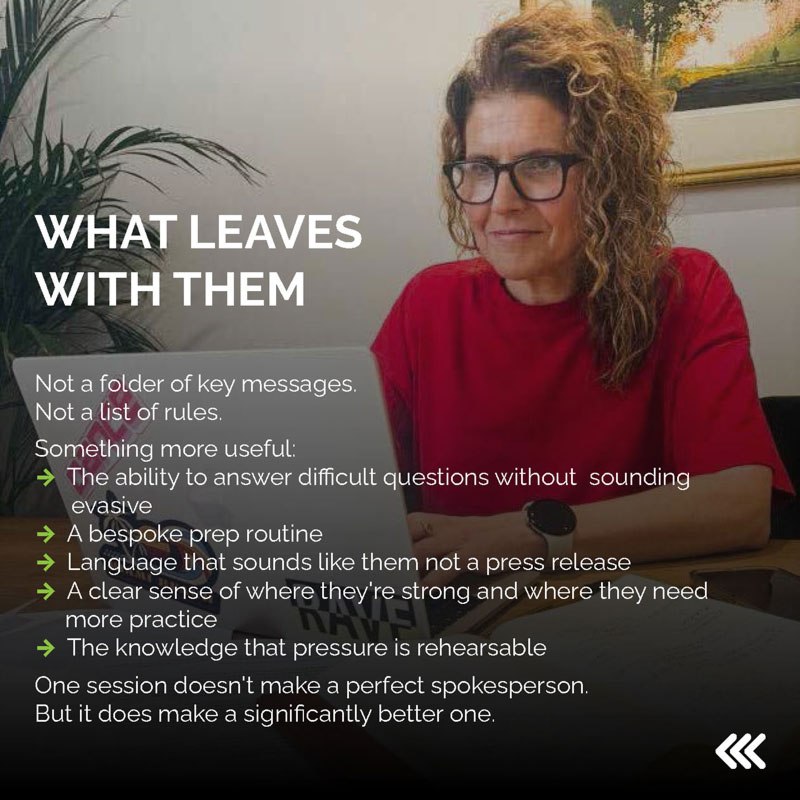
Are they ready? Can they handle the difficult questions without sounding evasive? Do they know where a journalist is heading before they get there? Can they sound like themselves under pressure not like a script?

If the answer to any of those is “I’m not sure,” that’s when we start working together.

Most of the work I do falls into three areas.

  • Media training preparing spokespeople to handle interviews, difficult questions and high-pressure moments without sounding robotic or exposed.
  • Crisis communications working alongside leadership teams when something has happened that needs managing carefully and quickly.
  • Executive profiling helping senior leaders find their voice, which holds up under scrutiny.

It’s not theoretical work.

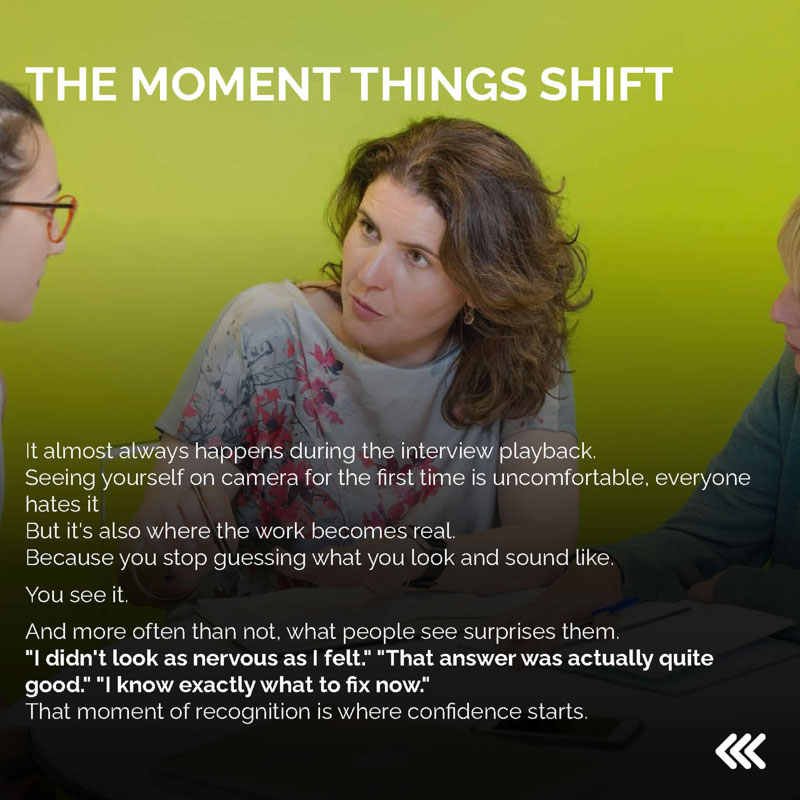
Instead, it’s practical, it’s rehearsal, it’s watching yourself back and seeing exactly what needs fixing before the moment actually matters.

If you’re in that position, where you’ve got people who need to be ready and you’re not entirely sure they are, that’s the work we do.

And it’s worth getting it right.

If you have an upcoming announcement or a difficult conversation on the horizon, don’t leave your reputation to chance. Explore our corporate communications services to see how we can help your leaders find their voice.

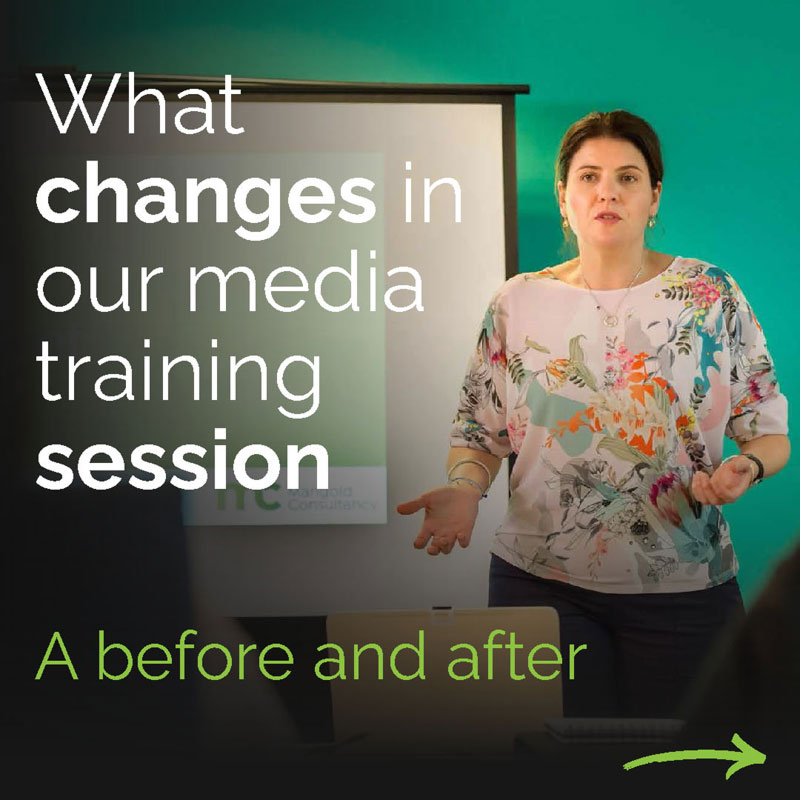
What changes during a media training session

Workshop with Mangold Consultancy

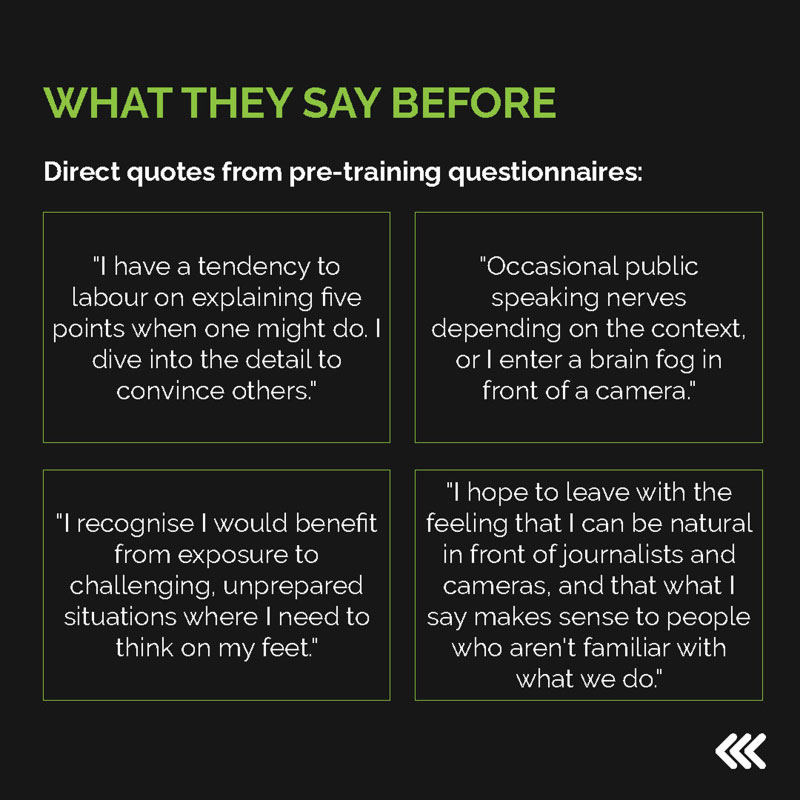
Before every training session, I send clients a short questionnaire to understand their specific goals and anxieties.

One question I always ask: “What are you most nervous about?”

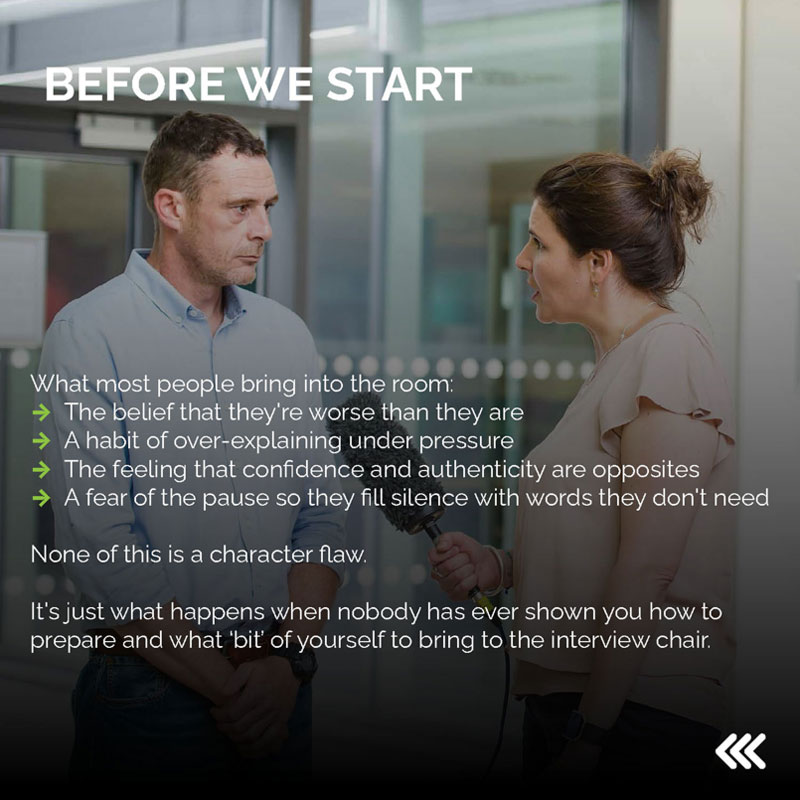
The answers are remarkably consistent.

  • “I overcomplicate things when I’m under pressure.”
  • “I’m worried I won’t be able to answer a question.”
  • “I worry I’ll sound robotic if I stick to the key messages.”

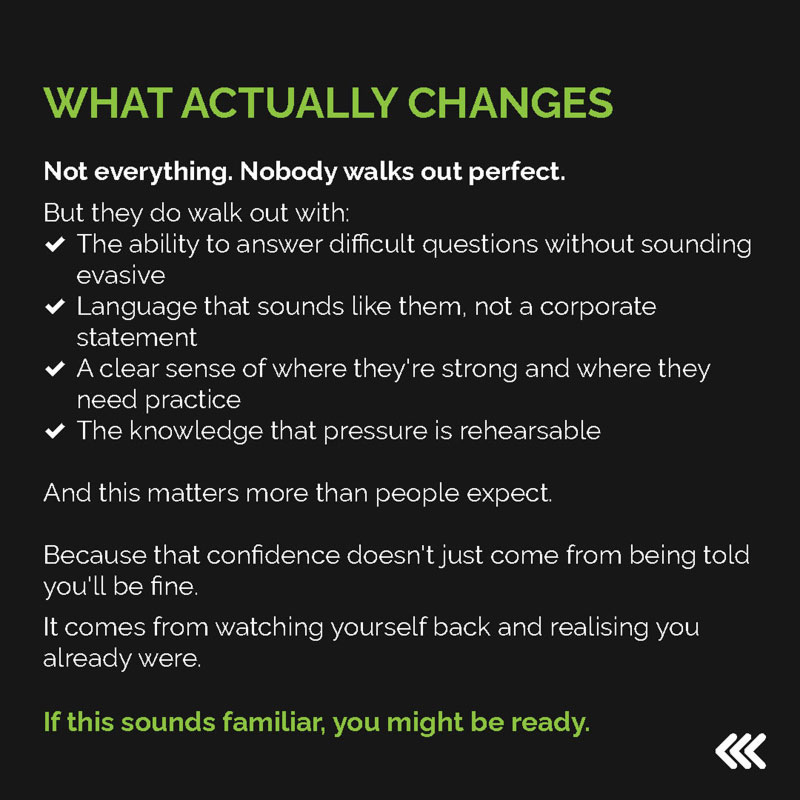
What’s interesting is that by the end of the session, almost none of them are still worried about those things.

Not because we’ve eliminated the nerves.

But because they’ve seen themselves do it.

And that changes everything.

If you want to move past the nerves and find out what you are truly capable of in front of a camera, we can help. Discover how our tailored media training sessions can build your confidence and clarity.

How to create an internal crisis brief when you don’t have all the answers

Create an internal crisis brief

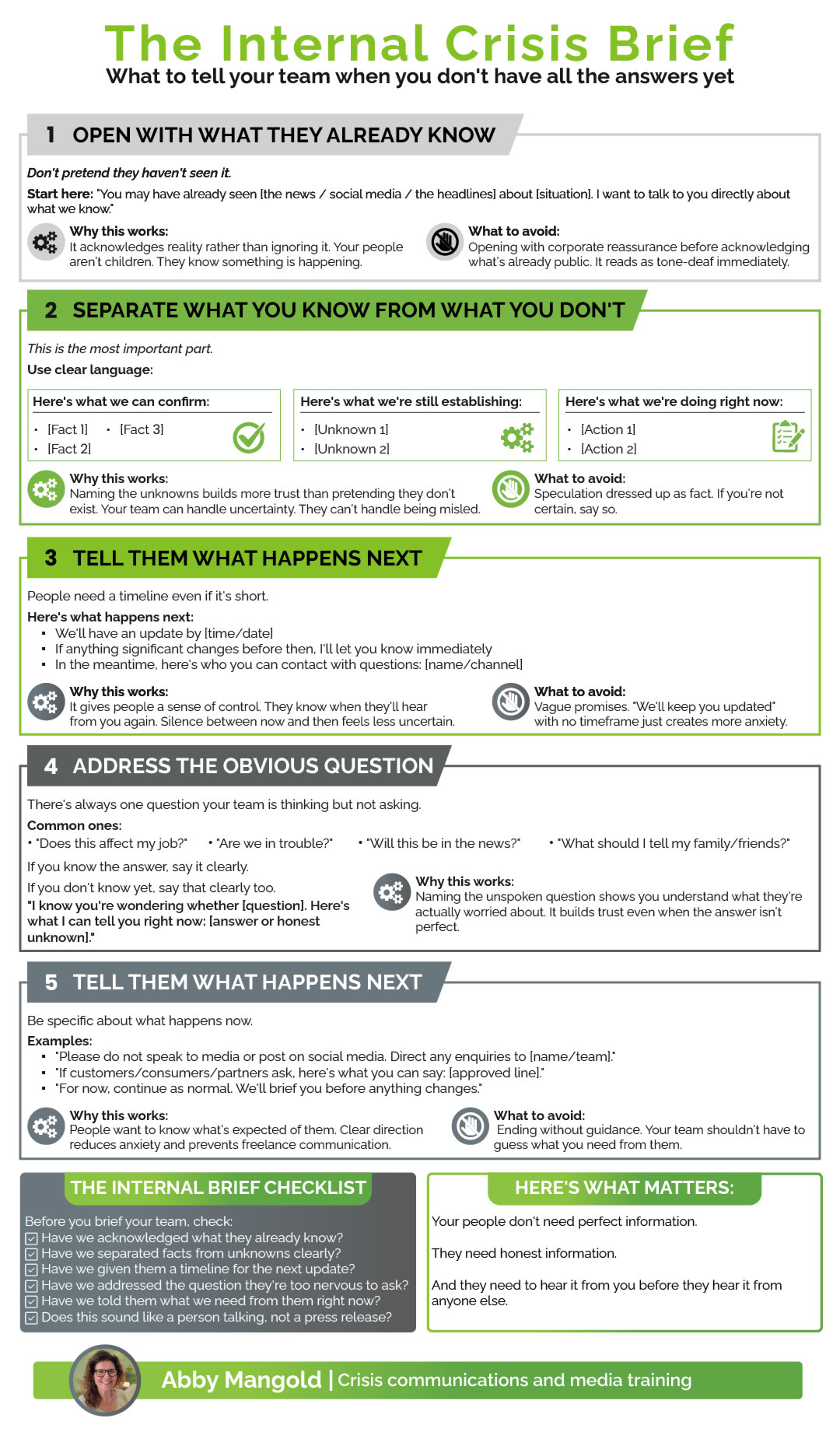
After my last post, a couple of people asked: “Right, but what does an internal crisis brief actually look like when we don’t have all the answers yet?”

Fair question.

Because the instinct is to wait until everything is confirmed, signed off, and legally approved.

But by that time, your people have already formed their own version of what’s happening.

And it’s almost always worse than the reality.

I’ve used this structure with clients for years. It’s not complicated. It’s not perfect.

But it works when you need to brief your team quickly and honestly, even when you’re still piecing things together yourself.

Save this. You’ll need it the next time something breaks before you’re ready.

The Internal Crisis Brief

Keeping your team informed during a period of uncertainty is the best way to protect your company culture. For expert support in developing your internal and external response plans, take a look at our crisis planning and preparation services.

Why your external statement shouldn’t be the first thing your staff see

Abby Mangold of Mangold Consultancy

Your employees found out about the crisis from X rather than from your own external statement.

And now you’re wondering why the internal mood feels… off

This happens more than organisations want to admit.

A crisis breaks. The comms team scrambles. Legal gets involved. The CEO needs to sign off. Hours pass.

And whilst everyone is perfecting the external statement, the people inside your building are already talking.

They’re in WhatsApp groups. They’re messaging each other. They’re refreshing the news.

And they’re wondering why nobody has told them anything.

I learned this the hard way many years ago.

A client issued a brilliant external statement. Thoughtful. Measured. Exactly right.

But their own team found out at the same time as everyone else.

The statement was fine. The damage was already done.

Because when your people hear it from the outside first, they stop feeling like insiders and in a crisis, they should be your ambassadors.

And that feeling doesn’t go away quickly.

Here’s the bit nobody wants to hear: your employees are your first audience.

Not your last.

Brief them first. Even if the brief is “here’s what we know, here’s what we don’t know yet, here’s when you’ll hear from us next.”

That’s still infinitely better than silence.

Because the external statement might protect your reputation.

But how you treat your people in the first hour is what protects your culture.

Protecting your culture is just as important as protecting your brand during a crisis. If you need help developing a robust communication plan for both internal and external audiences, please explore our crisis planning services.

Why organisations must do more to prepare their leaders for the media

Abby Mangold of Mangold Consultancy

I had a conversation recently about how organisations prepare their leaders that I haven’t been able to stop thinking about.

A very senior leader. Impressive organisation. Genuinely good communicator in the room.

I asked him: “If a journalist called you right now, what would you say?”

He smiled. “I’d refer them to our comms team.”

I pushed. “The comms team is unavailable. It’s you or no-one.”

The smile disappeared.

He had no answer.

And this is the thing that keeps me up at night about how organisations prepare their leaders.

We invest enormous amounts of time crafting the perfect statement.

The approved lines. The holding response. The Q&A document.

And then we hand it all to one person who has never once practised saying any of it out loud.

Under pressure.

With a camera on them.

Without the document in front of them.

A statement on paper and a spokesperson under pressure are two completely different things.

I’ve watched polished statements fall apart in thirty seconds because the person delivering them hadn’t rehearsed uncertainty.

Hadn’t practised the pause.

Hadn’t decided what they’d say when the journalist ignored the prepared answer and asked something else entirely.

Preparation isn’t the document.

Preparation is the person.

A prepared statement is only half the battle. If you want to ensure your team can handle the heat of a real interview, find out more about our media training and presentation skills sessions.

Why saying no comment is a risk to your reputation

Abby Mangold of Mangold Consultancy

Using “no comment” might feel like a safe option, but these two words are often anything but.

I spent years on the other side of this as a journalist. And I can tell you exactly what “no comment” communicates to the person asking the question.

It says you have something to hide.

It says the story just got more interesting.

Because journalists don’t hear “no comment” and move on.

They hear “keep digging, there’s something here.”

I understand why organisations default to it. Nobody has briefed the spokesperson. Legal hasn’t signed off. The full picture isn’t clear yet.

But there is always something you can say.

  • “We’re aware of the situation and we’re looking into it urgently.”
  • “We’ll have a full response by [time]. Here’s what we can confirm right now.”
  • “This matters to us and we’re working on the response this situation rightly deserves.”

None of these expose you.

All of them are infinitely better than two words that tell the world you’ve got something to hide.

“No comment” isn’t a communications strategy.

It’s the absence of one.

Handling a media enquiry correctly can make the difference between a resolved issue and a full-blown crisis. If you need help developing a clear communications strategy, please explore our crisis management services.

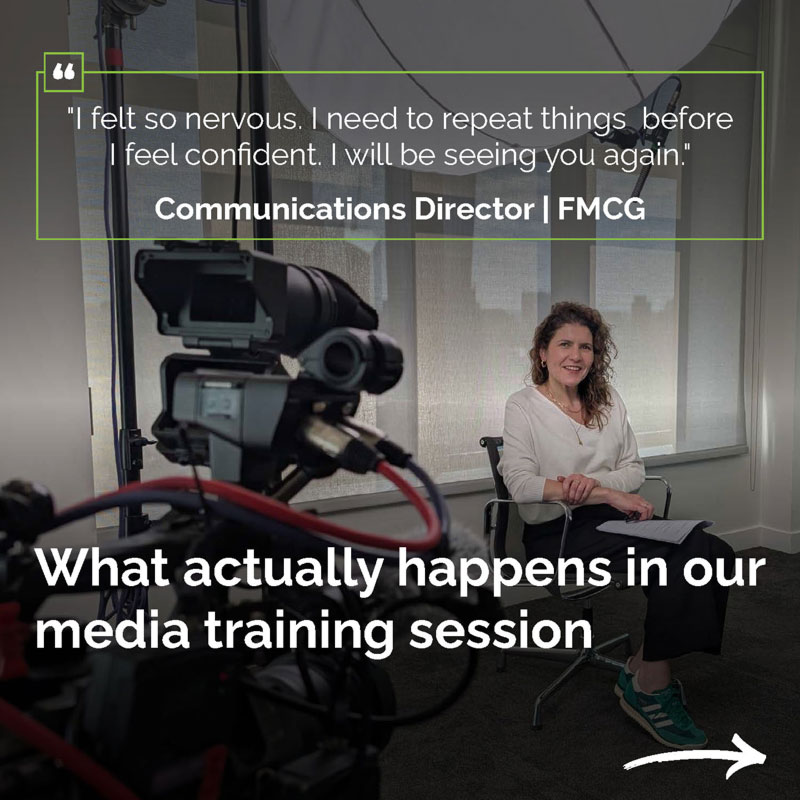
Overcoming the fear of media interviews through training

Overcoming the fear of media interviews

She came into the session convinced she was terrible at media interviews.

Fifteen years of experience. A genuine expert in her field.

But the moment a camera appeared, everything she knew seemed to disappear.

“I overcomplicate everything,” she told me beforehand. “I try to get across five points when one would do.”

At least she knew it.

What she didn’t know was why it kept happening and that it was completely fixable.

By the end of the day and the final interview, she watched herself back on camera and said something I hear more often than you’d think.

“I felt so much better prepared, and you can see that when I’m answering – such a big difference from my first interview!”

And it was.

It took just a few hours to help her find her voice.

If you or your team feel hesitant about facing the camera, our media training can help you find your voice and speak in media interviews with confidence. Please get in touch to see how we can help you prepare for your next interview.

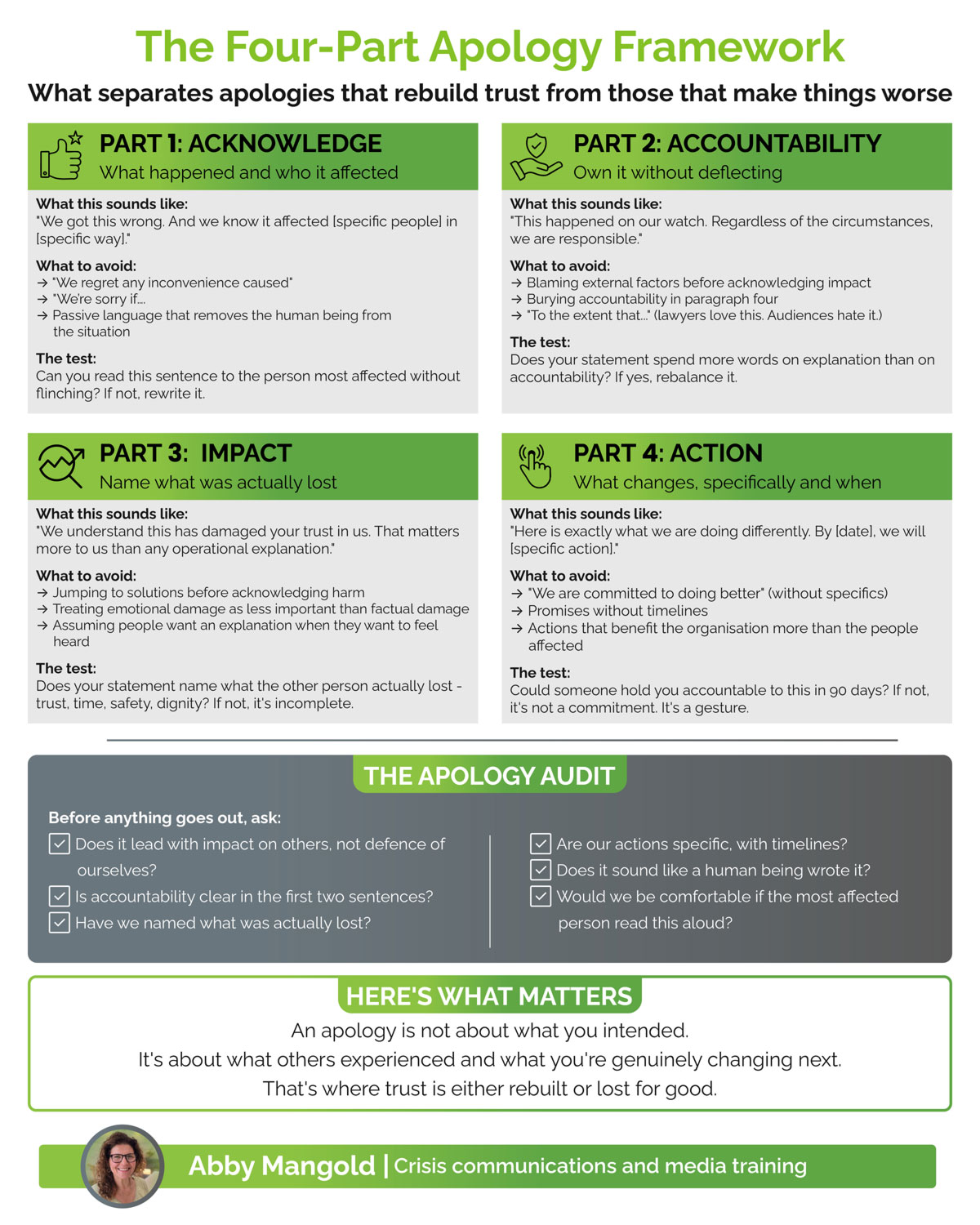
How to apologise publicly and rebuild trust with your audience

How to apologise publicly and rebuild trust

If you ever have to apologise publicly, most people get it wrong for the same reason.

Because the moment pressure hits, language changes.

Sentences get longer. Legal instinct kicks in. The focus quietly shifts from the people affected, to the organisation doing the apologising.

And the people reading it feel it immediately.

I’ve reviewed hundreds of public apologies over the years. The ones that rebuild trust and the ones that make things significantly worse.

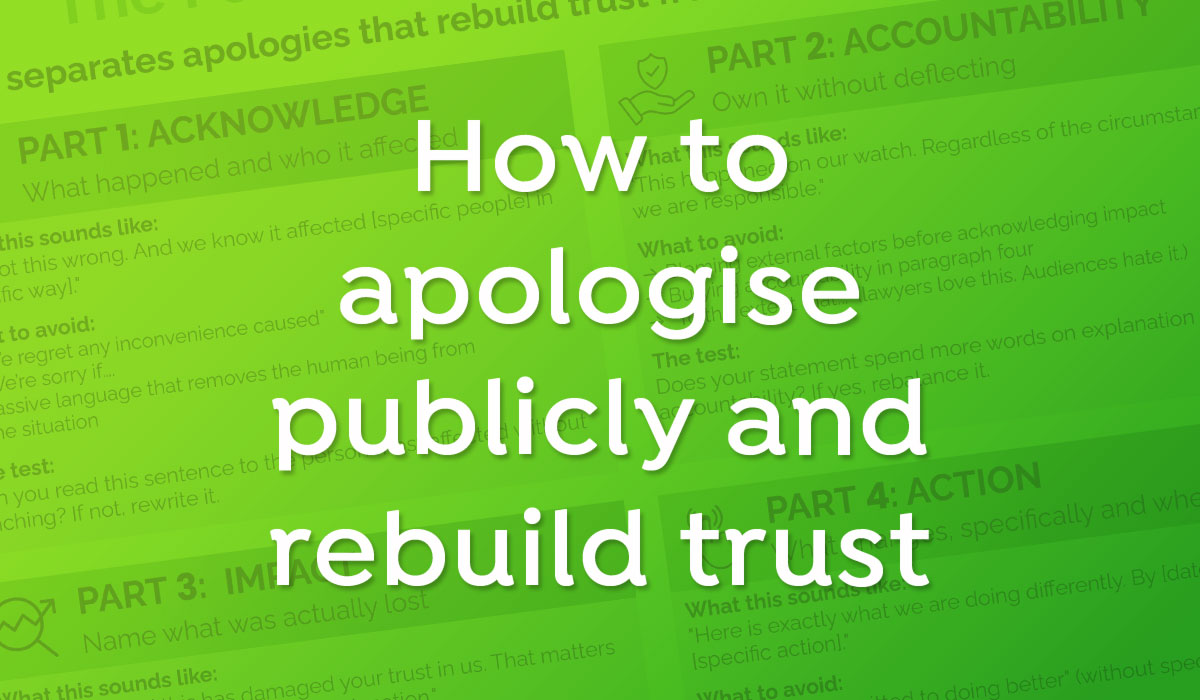
The difference almost always comes down to four things.

Not the words themselves.

The structure behind them.

I’ve put it into a framework I use with clients before any public apology goes out.

One test I always come back to: say it out loud, as if you’re speaking directly to the person affected.

If it doesn’t sound like something you’d say face-to-face, it won’t land as sincere.

Save this. You’ll need it.

The four part apology framework

Knowing how to apologise publicly is essential for your reputation. If you need strategic advice, please explore our crisis management services.

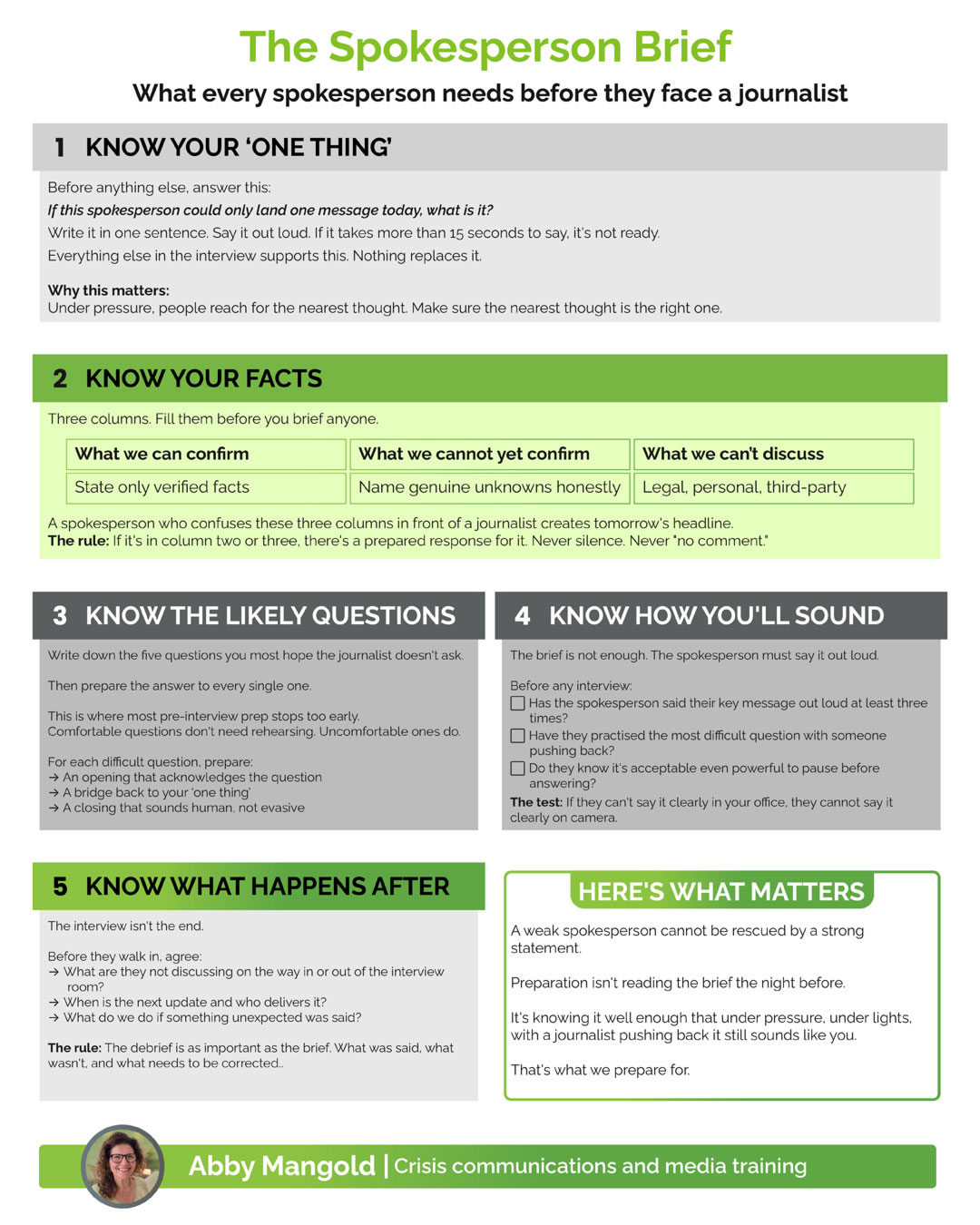
Why spokesperson preparation is the most important part of a crisis response

The Spokesperson Brief

Most organisations spend hours perfecting a statement but overlook spokesperson preparation.

They then hand that statement to someone who has often not seen it before that morning, and wonder why the interview doesn’t land.

A statement is only as strong as the person delivering it. Which means spokesperson preparation isn’t optional, it’s the most important part of your entire crisis response.

Over the years, I’ve developed a pre-interview brief I give every spokesperson before they face a journalist.

Not a script. Not a list of things to avoid. Rather, a brief that means they walk into that interview knowing exactly where they stand.

This is it.

The spokesperson brief

A strong statement is only effective if the person delivering it is ready for the pressure of a journalist’s questions. If you need to ensure your leaders are fully prepared, find out more about our media training and preparation services.

Will AI will create entirely new crisis problems?

Will AI will create entirely new crisis problems?

If you’re worrying that AI will create entirely new crisis problems, it probably won’t.

What it will do is speed up the ones that already catch people out.

  • Rushing when pressure hits.
  • Becoming defensive instead of deliberate.
  • Sounding confident before the facts are clear.
  • Going quiet without being intentional about it.

Those behaviours existed long before the tools did. They just show up faster now.

In the short statement below, I’ve set out what I keep seeing repeated, regardless of sector or technology. Not as a prediction, but as an observation from how crises actually unfold when time is tight and judgement matters.

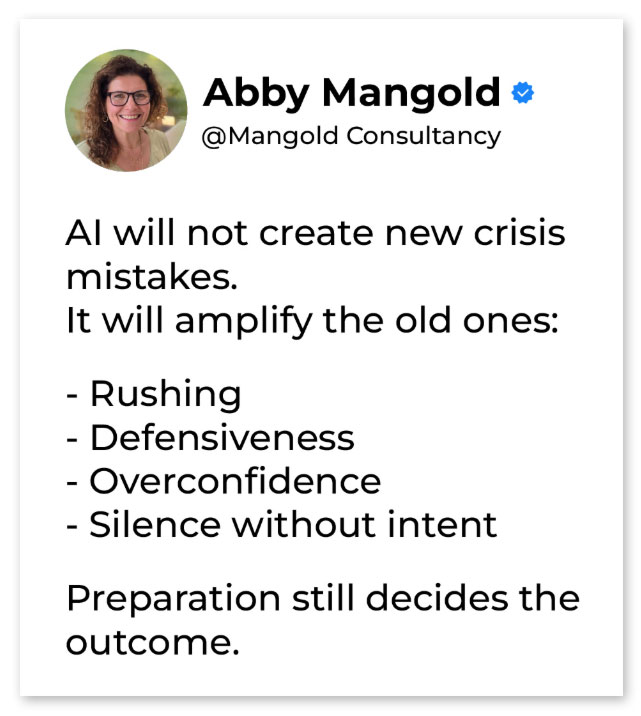
AI will not create new crisis mistakes, it will amplify the old ones…

Preparation still decides the outcome.

It always has.

The tools change.

The behaviour is what makes the difference.

Visit our 24/7 Strategic Counsel page to find out more about how we support organisations when judgement matters most.

How I would build a crisis response team today

Abby Mangold Working with small team

This is how I would build a crisis response team today (in the age of AI and fake videos).

This is based on what I have seen work when scrutiny is high and the margin for error is small.

First, I look for judgement before speed.

Fast reactions feel competent, but poor decisions travel quickly and are hard to pull back.

Second, I want people who are comfortable saying “we do not know yet”.

Credibility is damaged far more by speculating than by honesty.

Third, strong writing under pressure matters more than ever. Clear sentences. Plain language. No internal jargon.

If your team cannot write well at speed, no tool will fix it – even AI.

Fourth, human insight cannot be automated.

AI can summarise information.

It cannot read fear, anger or uncertainty in an audience.

Fifth, senior leaders value people who are willing to challenge them.

The right advice can be unpopular.

The strongest crisis teams stop bad decisions early.

Sixth, understanding how the media actually work is non-negotiable.

Not how organisations wish it worked.

Headlines, timelines and silence all carry consequences.

Finally, rehearsal beats reaction every time.

The most effective crisis teams I have worked with have practised long before they needed to perform.

AI can support crisis communications BUT It will not replace judgement, preparation or leadership under pressure.

If you are reviewing your crisis readiness for the year ahead, this is the capability mix I would prioritise if  building a crisis response team today.

Get in touch to find out more how Mangold Consultancy can help with your crisis readiness