
Why saying no comment is a risk to your reputation

Abby Mangold of Mangold Consultancy

Using “no comment” might feel like a safe option, but these two words are often anything but.

I spent years on the other side of this as a journalist. And I can tell you exactly what “no comment” communicates to the person asking the question.

It says you have something to hide.

It says the story just got more interesting.

Because journalists don’t hear “no comment” and move on.

They hear “keep digging, there’s something here.”

I understand why organisations default to it. Nobody has briefed the spokesperson. Legal hasn’t signed off. The full picture isn’t clear yet.

But there is always something you can say.

  • “We’re aware of the situation and we’re looking into it urgently.”
  • “We’ll have a full response by [time]. Here’s what we can confirm right now.”
  • “This matters to us and we’re working on the response this situation rightly deserves.”

None of these expose you.

All of them are infinitely better than two words that tell the world you’ve got something to hide.

“No comment” isn’t a communications strategy.

It’s the absence of one.

Handling a media enquiry correctly can make the difference between a resolved issue and a full-blown crisis. If you need help developing a clear communications strategy, please explore our crisis management services.

What I have learned about apologies under pressure

Apologies Under Pressure

Mastering apologies under pressure requires simplicity and a human touch. If you ever have to apologise publicly, this will matter more than you expect.

Most people don’t get apologies wrong because they don’t care. They get them wrong because pressure changes how they think. Language tightens. Legal instinct kicks in.

The focus shifts to intent, explanation and protection, often without realising it.

I’ve seen well-intended apologies make situations worse simply because they stopped sounding human.

Below I’ve set out what I’ve learned about apologies under pressure. These are based on the patterns that show up again and again, when statements are drafted quickly, reviewed heavily and read closely by the people who matter most.

What works is usually simplicity.

An apology is about what others experienced and what changes next. That’s where trust is either rebuilt or lost.

What works and what doesn’t when delivering apologies under pressure

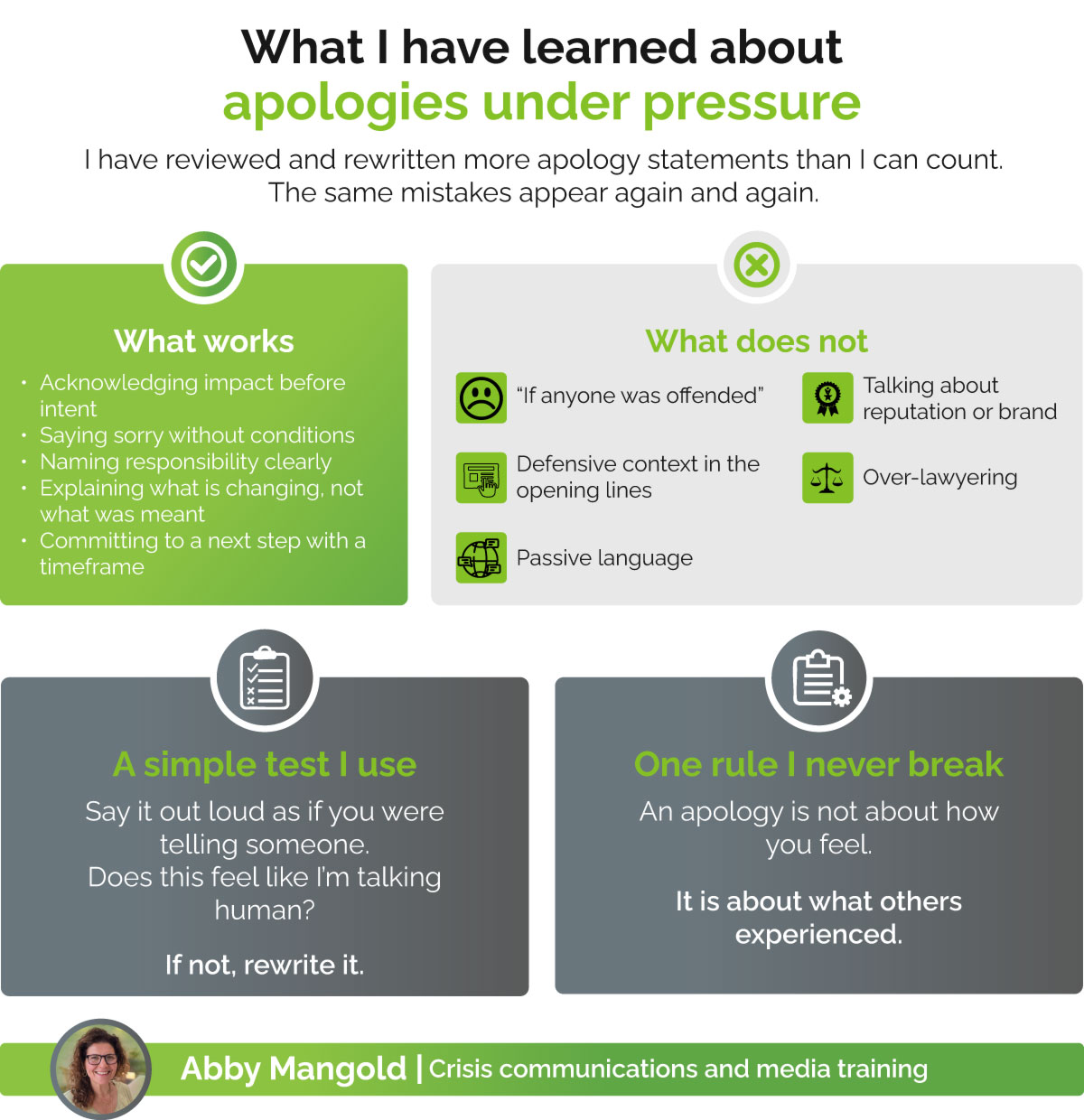
I have reviewed and rewritten more apology statements than I can count, and the same mistakes appear again and again

What works

  • Acknowledging impact before intent
  • Saying sorry without conditions
  • Naming responsibility clearly
  • Explaining what is changing, not what was meant
  • Committing to a next step with a timeframe

What does not work

  • “If anyone was offended”
  • Defensive context in the opening lines
  • Passive language
  • Over-lawyering
  • Talking about reputation or brand

A simple test I use

One test I always come back to is this:

Say it out loud, as if you were speaking directly to the person affected. If it doesn’t sound like something you’d say face to face, it won’t land as sincere.

 Does this feel like I’m talking human? If not, rewrite it.

One rule I never break

An apology is not about how you feel.

It is about what others experienced.

Contact us to discuss how we can help you craft sincere and effective corporate communications that protect your reputation.

What I have Learned About Apologies Under Pressure

Briefing tour crisis spokesperson: 5 Top Tips

Abby Mangold Top Tips for Briefing

If you’re briefing a spokesperson before an interview in a crisis situation, there is a high chance that you’ve got a lot to juggle.

You’re probably managing multiple communications to people inside and outside the organisation while responding to a fast-changing situation in a swirl of facts and rumours.

So, to get the most out of your time and support your spokesperson in this really challenging environment, these are my top tips:

Top tips for briefing your CEO / spokesperson in a crisis.

  1. Block out time for rehearsal interviews. I promise you they will thank you for it.
  2. Walk through some physical prep so that they can limber up.
  3. Run practice questions which probe around rumour and speculation.
  4. Build in comfort breaks, a gulp of water, a snack – especially if they’ve got multiple interviews.
  5. Pinpoint a clear interview entrance and exit strategy, especially if things run over.

These are the things your spokesperson needs from you to help them give their best performance